We're loading the full news article for you. This includes the article content, images, author information, and related articles.
For decades, women in Ijara dodged hyenas and trekked 10km daily for dirty water. Now, a solar-powered revolution is flowing from the taps.
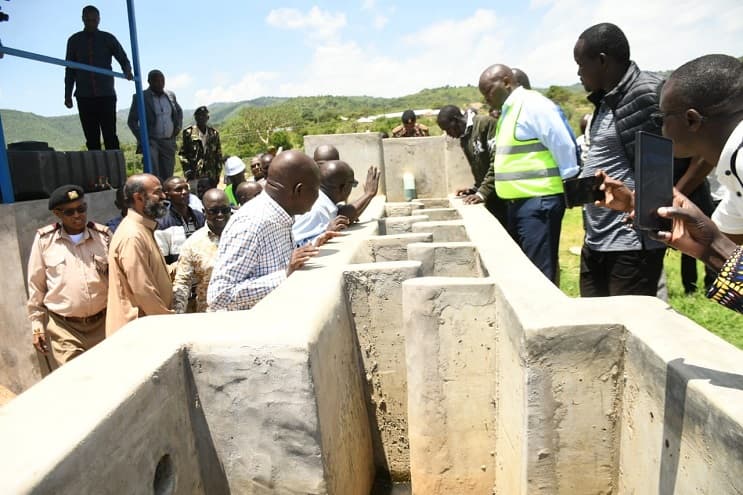
For the women of Kotile village in Garissa County, the definition of a “good morning” used to be simply surviving the trek. For as long as memory serves, the dawn ritual involved a perilous five-kilometer walk through the Ishaqbini Conservancy—territory claimed by hyenas and baboons—just to fetch jerrycans of brown, silt-heavy water.
That era of danger and drudgery has officially ended. In a landmark development for the region, the Water Sector Trust Fund (WaterFund), in partnership with the Garissa County Government and other stakeholders, has commissioned the KES 104.3 million Ishaqbini Conservancy Water and Sanitation Project (ICWSP). The initiative effectively rewrites the daily reality for 960 households across 30 villages, replacing scarcity with a steady flow of 30,000 cubic meters of clean water.
To understand the magnitude of this project, one must first understand the price residents paid for water. It was not just a financial cost; it was a tax on time, safety, and dignity.
“I used to go to Ishaqbini to fetch water as early as 6am and return as late as 1pm,” recalled Ms. Fardosa Omar Abdi, a resident of Kotile. “You can see I was wasting a lot of time that I could use in making my home.”
Beyond the lost hours, the journey was a gamble with life. Ms. Abdi noted that women were frequently at risk of attacks by wildlife. “We were putting our lives at risk because there are hyenas in the conservancy. Sometimes baboons would chase us,” she added. The return journey involved rolling heavy 20-liter jerrycans along the rough ground, a physically breaking task that defined womanhood in the area for generations.
The solution, now operational, is a feat of collaborative engineering. The project entailed drilling a high-capacity borehole equipped with a solar-powered pumping system—a critical feature in a region with abundant sunshine but unreliable grid power.
According to project specifications, the infrastructure includes:
Financing this lifeline required a coalition of partners. Of the total KES 104.3 million, WaterFund invested the lion's share at KES 70.2 million, with support from the Royal Danish Embassy. The Garissa County Government contributed KES 23.4 million, while the Northern Rangeland Trust (NRT) added KES 10.7 million.
While the taps are the visible triumph, the project’s impact on sanitation is arguably just as vital for public health. Waterborne diseases have long plagued Ijara, keeping children out of class and draining family incomes on medical bills.
Ms. Asha Godow Hassan, a parent in Kotile, emphasized the shift. “My children used to miss school every month because of sickness, but now they learn and play without worrying about getting sick,” she said.
To cement these gains, WaterFund constructed seven four-door VIP latrines across three public primary schools. Furthermore, through the Community Led Total Sanitation (CLTS) approach, the project facilitated improved sanitation for 1,056 households. Mr. Ahmed Maalim, the Conservancy Manager, confirmed that 30 villages have now been declared Open Defecation Free (ODF), a critical milestone in preventative healthcare.
The arrival of water is also reshaping the local economy, which is heavily reliant on pastoralism. In the past, the search for water forced herders to migrate as far as Lamu, stressing the livestock and reducing productivity.
Mr. Barre Hussein Dakane, Chairman of the Ishaqbini Hirola Community Conservancy, observed that the local herds now have consistent access to water, which has directly boosted milk yields. “With increased availability of milk and water, the health of expectant mothers and children is assured,” he noted.
For the residents of Ijara, the shiny new water pump is more than infrastructure; it is a promise kept. Standing beside the facility, Mr. Dakane summed up the sentiment of the entire sub-county: “Today, my friends, we begin a new chapter. Water has brought us life.”
Keep the conversation in one place—threads here stay linked to the story and in the forums.
Sign in to start a discussion
Start a conversation about this story and keep it linked here.
Other hot threads
E-sports and Gaming Community in Kenya
Active 9 months ago
The Role of Technology in Modern Agriculture (AgriTech)
Active 9 months ago
Popular Recreational Activities Across Counties
Active 9 months ago
Investing in Youth Sports Development Programs
Active 9 months ago



