We're loading the full news article for you. This includes the article content, images, author information, and related articles.
An artificial‑intelligence boom has dominated business headlines since late 2022. Venture capital and Big Tech spending on data‑centres and generative models have surged
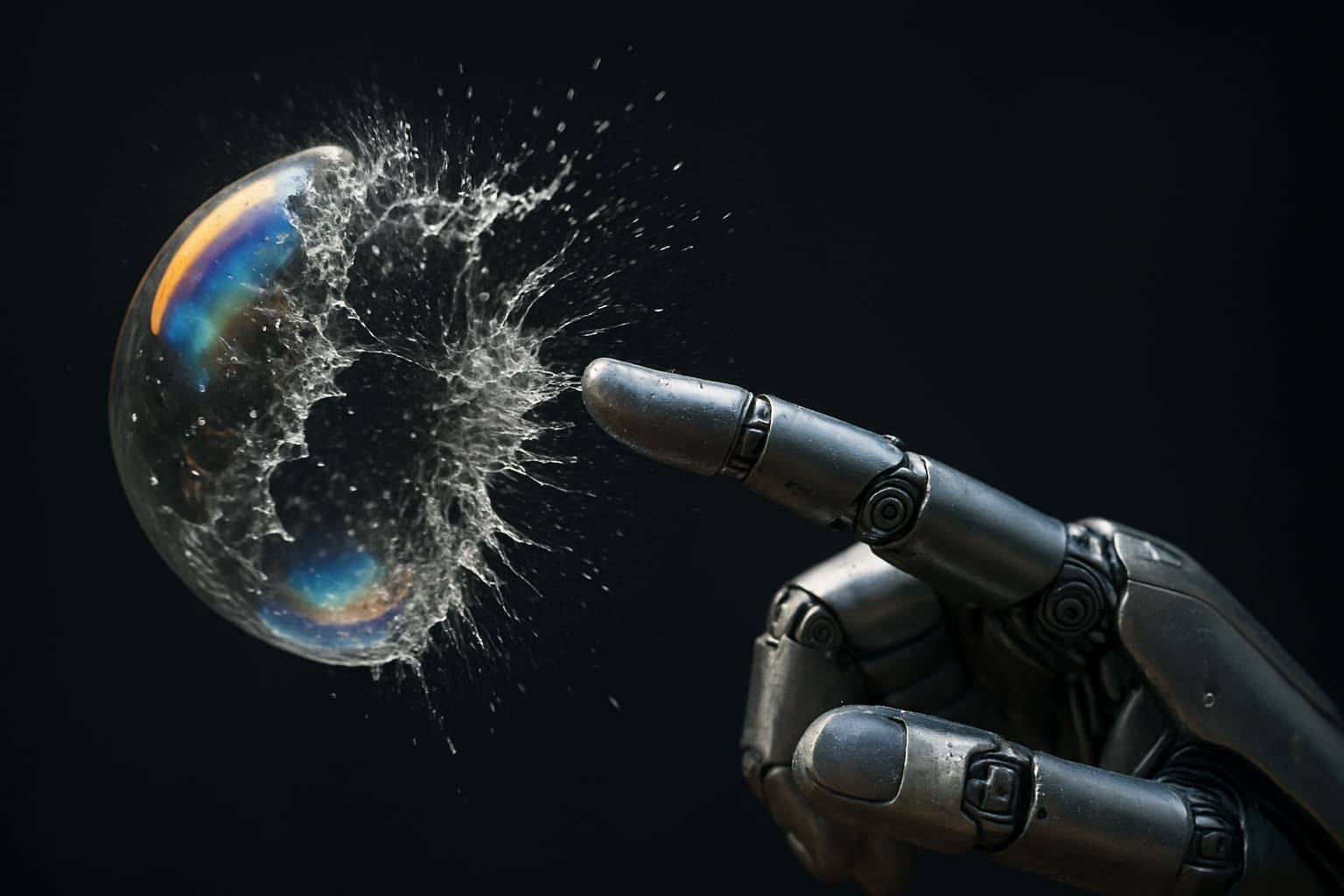
An artificial‑intelligence boom has dominated business headlines since late 2022. Venture capital and Big Tech spending on data‑centres and generative models have surged, yet public enthusiasm for machine‑generated content is declining and Wall Street analysts whisper about an imminent correction . In this environment Apple Inc. faces criticism for releasing modest generative features under the banner Apple Intelligence—critics call the effort a failure . This article argues that Apple’s restrained approach and focus on reliability may actually position it to weather a potential AI bubble. Lessons from the dot‑com crash show that underlying technologies survive while unsustainable business models collapse . If generative AI undergoes a similar correction, Apple’s “failure” could be its greatest strategic advantage.
Recent surveys suggest that consumers are growing weary of AI‑generated content. MarTech reports that 45 % of Generation Z and 44 % of Boomers oppose the use of AI in advertising , signalling a generational consensus. A study of holiday advertising by NIQ found that people describe AI‑generated ads as “annoying,” “boring,” and “confusing,” and low‑quality AI ads create cognitive overload and damage brand trust . Coca‑Cola’s 2025 AI‑designed holiday campaign saw positive social sentiment plunge from 23.8 % before release to just 10.2 % after audiences viewed the final ad ; commentators called it a “sloppy eyesore” . These reactions reflect a broader AI fatigue and highlight that AI‑generated art often lacks the human connection audiences expect .
The investment community is increasingly anxious that generative AI spending has become detached from economic reality. Reuters notes that executives and regulators have started to warn of irrational exuberance reminiscent of the dot‑com era; Alphabet CEO Sundar Pichai acknowledges “elements of irrationality,” and the Bank of England warns that a rapid market correction could be triggered by AI investments . Bryan Yeo of Singapore’s GIC sees a disconnect between “huge supply of AI” and slow enterprise adoption . An MIT Media Lab survey found that 95 % of enterprise generative‑AI pilots show no business return, and only 5 % of custom tools reach production; the tools struggle to retain context and rarely become mission‑critical . These data underscore that enormous investment is flowing into systems that have yet to demonstrate clear economic value.
Commentators describe the current phase as a “YOLO” period in which startups raise capital on promises rather than performance. The Institute for New Economic Thinking argues that the AI data‑centre boom is a bubble: trillions are being spent building infrastructure that may never pay for itself because training and inference costs rise faster than revenue and only a small fraction of users pay for premium AI services . The organisation points to circular financing loops among chip manufacturers, cloud providers and AI labs, warning that risk is concentrated in a few firms . As with the late‑1990s internet frenzy, many companies are “wildly overextended” and built on unsustainable promises .
Historians of the dot‑com boom note that the internet itself did not fail; rather, speculative investments collapsed while the underlying technology matured. During the early 2000s crash, companies like Pets.com vanished because they lacked viable business models, yet the internet emerged stronger and transformed global commerce . The Guardian’s analysis warns that speculative manias are recurring features of capitalism: dot‑com, housing and now AI . The key question is what legacy the AI boom will leave. Economists estimate that a correction on the scale of the dot‑com crash could erase trillions in household wealth . By recalling that the dot‑com bust weeded out unsustainable ventures while preserving transformative technologies, we can better evaluate today’s AI exuberance.
At Apple’s 2025 Worldwide Developers Conference the company unveiled Apple Intelligence, a suite of AI features including text summarization, on‑device image generation and tighter ChatGPT integration. Critics derided the demos as underwhelming; generative images looked amateurish, and ChatGPT was “shoehorned into Siri” . In a subsequent interview, software chief Craig Federighi admitted that the version of conversational Siri the team built “worked great on the path we intended” but went off the rails when users deviated from those paths, and the company was unwilling to ship an unreliable product . Apple thus delayed advanced features until they can meet the firm’s quality standards. A research paper from Apple scientists underscores this caution: large reasoning models suffer an accuracy collapse as problem complexity increases, meaning claims of reasoning may be an illusion . In other words, Apple’s engineers know that the technology is brittle and that reliability demands restraint.
Rather than chasing flashy chatbots, Apple has built a hybrid AI architecture that keeps most processing on device. The Okoone consultancy explains that Apple Intelligence combines machine‑learning models and large language models with a privacy‑first design: tasks are executed locally when possible, and more complex queries use Private Cloud Compute, which encrypts data and destroys it after inference . Siri improvements that enable context‑aware actions and multi‑step commands were announced for late 2025 or 2026, underscoring Apple’s long‑term roadmap . Apple has also invested heavily in hardware: its $500 billion U.S. investment plan includes building a dedicated server facility that will assemble energy‑efficient AI servers with custom silicon . Unlike rivals who rely on expensive Nvidia GPUs, Apple runs AI workloads on the same chips used in MacBooks, which cost hundreds rather than tens of thousands of dollars . A 2025 report notes that Apple’s capital expenditure was $12.7 billion—far below Amazon’s $125 billion and Meta’s $71 billion—because Apple uses a hybrid strategy of building its own servers and renting third‑party compute when necessary . This conservative investment positions Apple to benefit from AI capabilities while avoiding overexposure to a potentially deflating bubble.
Apple’s hardware strategy extends beyond AI. The company uses generative AI to accelerate chip design and to create dedicated server chips, but those innovations also improve traditional silicon engineering . Apple’s AI optimisations thus deliver value whether or not generative AI becomes a dominant revenue source. By vertically integrating hardware, software and services, Apple controls its own infrastructure and is insulated from spiralling data‑centre costs . Building servers that run on 100 % renewable energy also enhances sustainability and reduces reliance on external suppliers . This contrarian, patient strategy contrasts sharply with peers racing to deploy generic chatbots on massive cloud infrastructure.
Many generative‑AI services appeal to curiosity rather than solving real problems. The MIT Media Lab’s survey of enterprise AI pilots found that most projects did not reach production and offered no measurable business return, suggesting a mismatch between hype and utility . The Institute for New Economic Thinking argues there is no plausible scenario where the trillions of dollars invested in data‑centre construction pay off because training and inference costs rise faster than revenue, very few users pay for premium AI services, and competition will push prices down . Start‑ups built on wishful thinking risk collapsing when investors demand profitability .
AI systems also undermine trust by blurring the boundary between real and synthetic. A Swansea University study showed that participants could not reliably distinguish AI‑generated images of fictional and famous people from real photographs . The researchers warn that such imagery could be used to fabricate endorsements or political stances . UNESCO calls deepfakes a “crisis of knowing” because seeing and hearing are no longer believing; simply trying to detect fakes is insufficient, and the knowledge ecosystem must be rebuilt . Synthetic media also fuel identity fraud: 46 % of fraud experts have encountered synthetic identity scams, and U.S. fraud losses could rise from $12.3 billion in 2023 to $40 billion by 2027 . These trust issues compound the economic concerns and suggest that quality and authenticity will be paramount for long‑term adoption.
Beyond economics and trust, society faces ethical dilemmas about handing creativity and decision‑making to machines. The INET article questions whether scaling current models will achieve artificial general intelligence and whether the world can support the energy demands of infinite model training . The Guardian warns that Big Tech has raised nearly $250 billion in debt to finance AI buildouts and asks what happens if promised revenues fail to materialise . Unchecked AI development could entrench misinformation, bias and job displacement. Guardrails, transparency and human oversight are necessary to navigate this moral crossroads.
In this volatile landscape Apple’s supposed AI failure looks more like strategic prudence. By deliberately delaying conversational AI until it meets reliability standards and by designing a privacy‑first system , Apple avoids over‑promising and under‑delivering. Its focus on custom hardware and hybrid processing means AI investments dovetail with broader product strategy and remain useful even if generative AI enthusiasm fades . With capital expenditure far below competitors’ and a diversified revenue stream, Apple is insulated from the risk that an AI bubble bursts . When the speculative frenzy cools and unsustainable players collapse, companies that prioritised quality, privacy and tangible value will be best positioned to innovate sustainably.
The generative‑AI boom has fuelled unprecedented investment and imaginative speculation. Yet signs of fatigue, backlash and economic overreach suggest that a correction is likely. History teaches that technological revolutions outlast speculative bubbles ; the internet survived the dot‑com crash, and valuable AI innovations will persist even if many current ventures fail. Apple’s cautious approach—emphasising reliability, privacy and vertical integration—demonstrates a path toward sustainable AI. Rather than chasing hype, stakeholders should focus on solving real problems, protecting authenticity, and preparing society for the ethical challenges ahead. Only then will AI’s promise outlast the bubble.
|
Evidence of fatigue |
Statistic or insight |
|---|---|
|
Consumers oppose AI in ads |
45 % of Gen Z and 44 % of Boomers say no to AI advertising |
|
Perception of AI ads |
NIQ found AI ads are considered annoying, boring and confusing |
|
Reaction to Coca‑Cola AI holiday ad |
Positive sentiment fell from 23.8 % pre‑launch to 10.2 % after release |
|
Source |
Warning |
|---|---|
|
Reuters & Bank of England |
Executives see irrationality reminiscent of dot‑com era; central bank warns a market correction could be triggered by AI investments |
|
MIT Media Lab survey |
95 % of enterprise AI pilots show no return and only 5 % reach production |
|
INET analysis |
Data‑centre spending may never be recouped; training/inference costs rise faster than revenue |
|
Guardian analysis |
Big Tech has raised nearly $250 billion in debt to fund AI; a dot‑com scale crash could destroy trillions in wealth |
|
Aspect |
Apple |
Many peers |
|---|---|---|
|
Capex on AI infrastructure |
$12.7 billion in 2025; uses hybrid strategy of building custom servers and renting when needed |
Amazon spent $125 billion and Meta $71 billion on data‑centre expansion |
|
Processing location |
On‑device first with Private Cloud Compute for complex tasks |
Mostly cloud‑based, sending user data to remote servers |
|
Investment focus |
Custom silicon, privacy, energy‑efficient servers |
Expensive GPUs and large cloud facilities |
|
Timeline for advanced features |
Delayed conversational Siri until reliability is sufficient ; context‑aware actions promised for 2025/26 |
Rushed deployment of chatbots, often with hallucinations and limited utility |
Keep the conversation in one place—threads here stay linked to the story and in the forums.
Sign in to start a discussion
Start a conversation about this story and keep it linked here.
Other hot threads
E-sports and Gaming Community in Kenya
Active 9 months ago
The Role of Technology in Modern Agriculture (AgriTech)
Active 9 months ago
Popular Recreational Activities Across Counties
Active 9 months ago
Investing in Youth Sports Development Programs
Active 9 months ago