We're loading the full news article for you. This includes the article content, images, author information, and related articles.
After 245 days in orbit, a Navy SEAL-turned-astronaut and two cosmonauts are minutes away from a high-stakes landing on the Kazakh steppe.
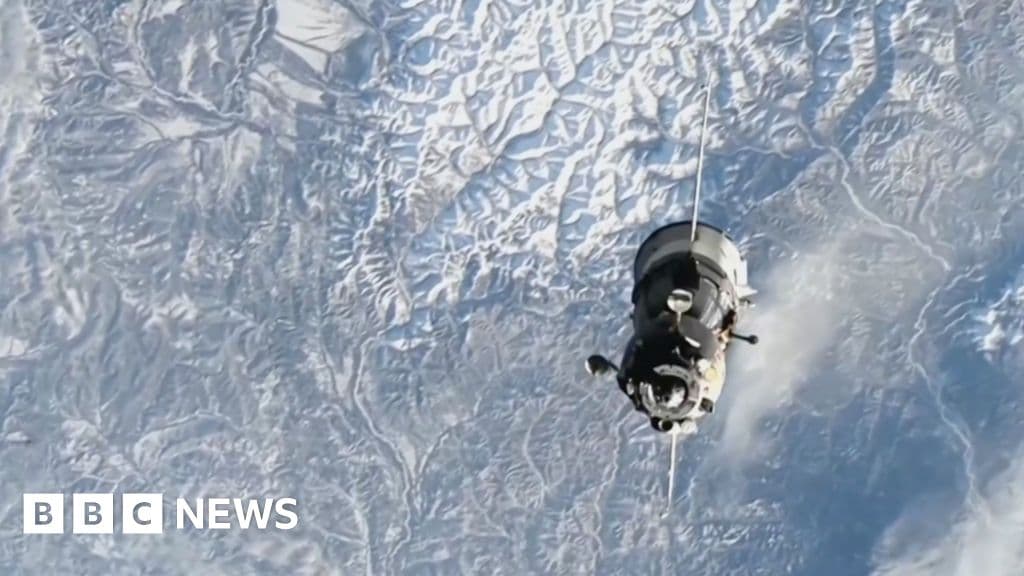
NAIROBI — As you read this, three men are plummeting through the Earth’s atmosphere at speeds that would turn ordinary machinery into molten slag. Encased in the Soyuz MS-27 capsule, NASA astronaut Jonny Kim and Russian cosmonauts Sergey Ryzhikov and Alexey Zubritsky are enduring the final, fiery leg of a 245-day odyssey that began last April.
The trio is scheduled to touch down on the frozen steppe of Kazakhstan at exactly 8:04 a.m. EAT today, bringing an end to a mission that has tested the limits of human endurance. For Kim, a Harvard-trained doctor and decorated Navy SEAL, this return marks the completion of his first spaceflight—a journey of nearly 167 million kilometers that saw him orbit the planet 3,920 times.
While the drama unfolds in Central Asia, the implications of their work ripple all the way to Nairobi. The science conducted aboard the International Space Station (ISS)—from microgravity crop growth to water purification—holds critical data for nations like Kenya, where climate resilience is not just a buzzword, but a survival strategy.
The return journey is a masterclass in physics and precision. The crew undocked from the ISS’s Prichal module earlier this morning, initiating a deorbit burn to slow their spacecraft and drop it from orbit. Currently, they are navigating the most dangerous phase: re-entry.
Friction with the atmosphere is heating the capsule’s heat shield to over 1,600 degrees Celsius. Inside, the crew is experiencing up to four times the force of gravity, their bodies pressing heavily into custom-molded seats after eight months of weightlessness. NASA mission control has confirmed that all systems are nominal, but in spaceflight, nothing is routine until the crew is breathing fresh air.
"The plasma trail has formed," a Roscosmos commentator noted during the live feed, referring to the superheated gas that briefly cuts off radio communications—a tense period known as the 'blackout zone.'
The human face of this mission is undeniably Jonny Kim. His biography reads like fiction: the son of South Korean immigrants who overcame a turbulent childhood to become a Silver Star recipient in the SEALs, then a physician, and finally an astronaut. His story resonates deeply in Kenya, where the ethos of kujituma (self-reliance/hard work) is celebrated.
"Jonny represents the pinnacle of multidisciplinary excellence," said Dr. Sarah Mutua, a Nairobi-based STEM advocate. "For a young Kenyan student looking at the stars, he proves that you don't have to choose between being a soldier, a scientist, or an explorer. You can be all of them."
Flying alongside him is Sergey Ryzhikov, a veteran commander completing his third tour, and rookie Alexey Zubritsky. Their camaraderie in orbit stands in stark contrast to the geopolitical tensions currently chilling relations between Washington and Moscow on the ground.
Why should a Kenyan taxpayer care about a multi-billion dollar descent in Kazakhstan? Because the space economy is no longer the exclusive playground of superpowers. The Kenya Space Agency (KSA) has been aggressively pursuing partnerships to leverage space tech for local benefit.
While the ISS costs upwards of $100 billion (approx. KES 13 trillion) to maintain, the democratization of space means Kenya can access vital data without bearing that astronomical price tag. The KSA’s recent launch of the Taifa-1 satellite is proof that Nairobi is moving from a consumer of space data to an active participant.
Once the parachutes deploy and the retro-rockets fire to cushion the landing, recovery teams will rush to extract the crew. They will be carried out of the capsule, unable to walk immediately as their bodies readjust to gravity. For Kim, Ryzhikov, and Zubritsky, the long voyage is ending. For the global scientific community—and emerging space nations like Kenya—the analysis of their work is just beginning.
As the capsule nears the ground, the world watches not just a landing, but a reminder of what cooperation can achieve. In a world often divided by borders, gravity remains the one law that binds us all.
Keep the conversation in one place—threads here stay linked to the story and in the forums.
Sign in to start a discussion
Start a conversation about this story and keep it linked here.
Other hot threads
E-sports and Gaming Community in Kenya
Active 9 months ago
The Role of Technology in Modern Agriculture (AgriTech)
Active 9 months ago
Popular Recreational Activities Across Counties
Active 9 months ago
Investing in Youth Sports Development Programs
Active 9 months ago