We're loading the full news article for you. This includes the article content, images, author information, and related articles.
In a global first, Washington shifts from aid agencies to a government-to-government model, entrusting the Ruto administration with billions to fight HIV and malaria—but the cash comes with strict 'America First' conditions.
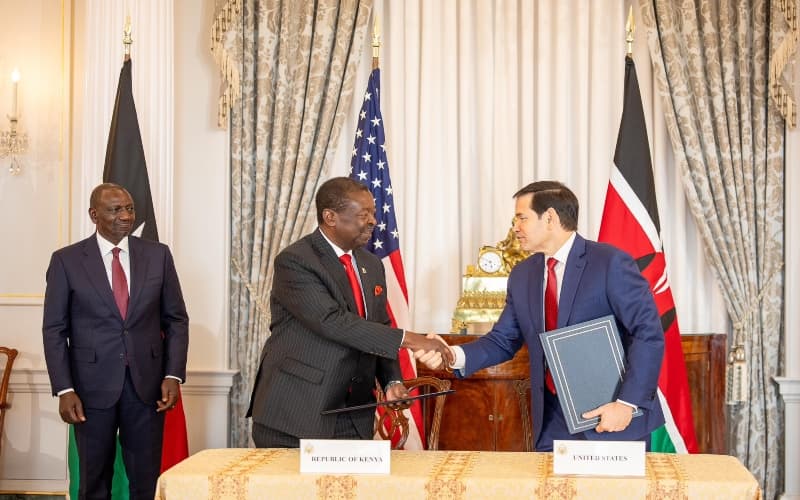
In a move that fundamentally rewrites the playbook of foreign aid, Kenya has become the first nation in the world to secure a direct government-to-government (G2G) health partnership with the United States. The historic agreement, signed Thursday in Washington, bypasses the traditional web of non-governmental organizations (NGOs) to place approximately $2.5 billion (KES 323 billion) squarely in the hands of the Kenyan state.
The deal marks a pivotal victory for President William Ruto’s administration, signaling a massive vote of confidence from the White House. However, it also places an unprecedented burden of accountability on a government often criticized for leakage in the public purse. For the common mwananchi, the shift promises a future where health services are integrated and sustainable, but it raises immediate questions about the fate of thousands of jobs in the donor-dependent NGO sector.
This partnership is the inaugural flagship of the new "America First Global Health Strategy" spearheaded by the Trump administration. Following the overhaul of USAID, Washington is pivoting away from what U.S. Secretary of State Marco Rubio termed the "NGO industrial complex."
"We are not going to spend billions of dollars funding the NGO industrial complex while close and important partners like Kenya either have no role to play or have very little influence over how health care money is being spent," Rubio emphasized during the signing ceremony. "We’re not doing this anymore."
Under the new framework, funds that previously flowed through international intermediaries will now be channeled directly to Kenyan government systems, including:
The financial scale of the agreement is staggering. Over the next five years, the total investment stands at $2.5 billion (approx. KES 323 billion). The breakdown reveals a shared burden:
Crucially, the deal includes a "sustainability clause." Kenya is expected to gradually absorb the costs of healthcare workers and commodities currently funded by the US, aiming for fuller self-reliance by 2030.
The money comes with strings attached. Washington has imposed rigorous surveillance targets to protect global health security. Nairobi must adopt a "7-1-7" system for disease outbreaks:
Failure to meet these metrics could jeopardize future tranches of funding. Additionally, the agreement stipulates that faith-based health providers must be treated on par with private and public facilities, ensuring they receive equal access to government reimbursements.
For many Kenyans, the burning question is not about the source of the money, but its safety. The decision to route billions through KEMSA—an agency previously dogged by the "Covid Billionaires" scandal—has raised eyebrows among civil society watchdogs.
President Ruto, who witnessed the signing by Prime Cabinet Secretary Musalia Mudavadi, moved quickly to assuage these fears. "I assure you that every shilling and dollar will be spent efficiently, effectively, and accountably," Ruto promised, framing the deal as a catalyst for his Bottom-Up Economic Transformation Agenda (BETA).
While the deal secures a lifeline for essential health services, it signals a nervous transition period for the local development sector. Analysts warn that the abrupt bypass of NGOs could lead to job losses for Kenyans employed by international aid agencies, even as the government promises to absorb health workers onto the public payroll.
"This cooperation framework is quite a departure from the past," noted Dr. Ouma Oluga, Principal Secretary for Medical Services. "It will have a lasting impact on health for all, but it demands we step up as a nation to own our future."
Keep the conversation in one place—threads here stay linked to the story and in the forums.
Sign in to start a discussion
Start a conversation about this story and keep it linked here.
Other hot threads
E-sports and Gaming Community in Kenya
Active 9 months ago
The Role of Technology in Modern Agriculture (AgriTech)
Active 9 months ago
Popular Recreational Activities Across Counties
Active 9 months ago
Investing in Youth Sports Development Programs
Active 9 months ago