We're loading the full news article for you. This includes the article content, images, author information, and related articles.
Guaranty Trust Bank Kenya has escalated its dispute with the Competition Authority of Kenya to the Competition Tribunal, contesting a KES 33.18 million penalty for alleged unconscionable conduct. The case highlights crucial battles over corporate governance and SME protection.
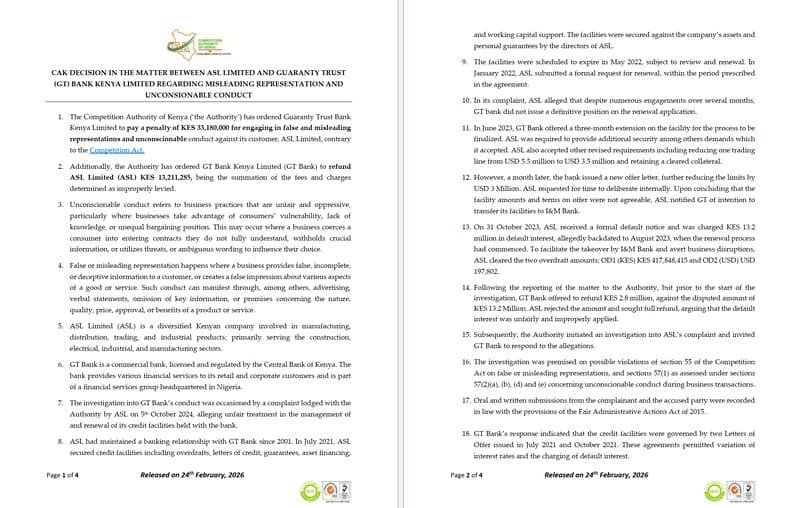
Guaranty Trust Bank Kenya has escalated its dispute with the Competition Authority of Kenya to the Competition Tribunal, contesting a KES 33.18 million penalty for alleged unconscionable conduct. The case highlights crucial battles over corporate governance and SME protection.
The Kenyan banking sector is witnessing a high-stakes regulatory showdown as Guaranty Trust Bank (GT Bank) formally appeals a severe financial penalty imposed by the Competition Authority of Kenya (CAK). The dispute centers on fiercely contested allegations of misleading representation and unconscionable conduct toward a long-standing corporate client.
This legal confrontation matters profoundly to the national economy. The relationship between commercial lenders and the Small and Medium Enterprise (SME) sector is the undisputed engine of Kenya's economic growth. When regulatory bodies clash with tier-tier financial institutions over client treatment, it sets pivotal legal precedents that govern how capital is distributed, managed, and abruptly recalled in the marketplace.
The conflict erupted following a ruling by the CAK, which directed GT Bank to pay a punitive fine of KES 33.18 million. Additionally, the regulator ordered the bank to refund KES 13,211,285 to ASL Limited—a client since 2001—citing improperly levied fees. The CAK's investigation was triggered by a complaint filed by ASL, alleging unfair treatment regarding the management and sudden non-renewal of essential credit facilities, including overdrafts, letters of credit, and asset financing.
In a staunch defense of its operational integrity, GT Bank released a statement rejecting the CAK's conclusions. The lender maintains that its conduct was entirely consistent with its contractual obligations and strictly adhered to all applicable Kenyan banking laws. Arguing that the Authority's findings lack factual and evidentiary support, the bank has opted to escalate the matter to the Competition Tribunal. Because the issue is now sub judice, the bank has refrained from further public commentary, trusting the appellate process to vindicate its actions.
For the wider East African financial ecosystem, this case is a litmus test for regulatory authority versus institutional autonomy. The CAK has increasingly bared its teeth in recent years, pivoting from merely monitoring mergers and acquisitions to aggressively prosecuting consumer protection violations. This aggressive posture aims to shield vulnerable businesses from arbitrary financial ruin caused by opaque banking practices.
If the Competition Tribunal upholds the CAK's ruling, it will send a shockwave through the banking halls of Nairobi. It would definitively establish that commercial banks cannot unilaterally sever vital credit lifelines without transparent, justifiable, and adequately communicated rationale, especially when dealing with legacy clients heavily reliant on working capital support.
As the Competition Tribunal prepares to dissect the evidence, the entire corporate sector is watching. A victory for GT Bank would reinforce the sanctity of private contracts and the bank's absolute right to manage its risk portfolio as it sees fit. Conversely, a victory for the CAK would enshrine a new era of heightened accountability, forcing lenders to meticulously document and justify every fee levied and every credit line denied.
Regardless of the outcome, the friction between GT Bank and ASL Limited serves as a critical warning to all market participants. The era of unchecked institutional leverage over commercial clients is facing unprecedented scrutiny, fundamentally altering the rules of engagement in Kenya's vibrant financial sector.
"In the complex theater of modern finance, the scales of justice must equally balance the institution's right to mitigate risk with the client's right to transparent survival."
Keep the conversation in one place—threads here stay linked to the story and in the forums.
Sign in to start a discussion
Start a conversation about this story and keep it linked here.
Other hot threads
E-sports and Gaming Community in Kenya
Active 9 months ago
The Role of Technology in Modern Agriculture (AgriTech)
Active 9 months ago
Popular Recreational Activities Across Counties
Active 9 months ago
Investing in Youth Sports Development Programs
Active 9 months ago