We're loading the full news article for you. This includes the article content, images, author information, and related articles.
Rio de Janeiro's iconic Carnival parades begin with a tribute to Brazil's President Lula, illustrating his rise from poverty to power.
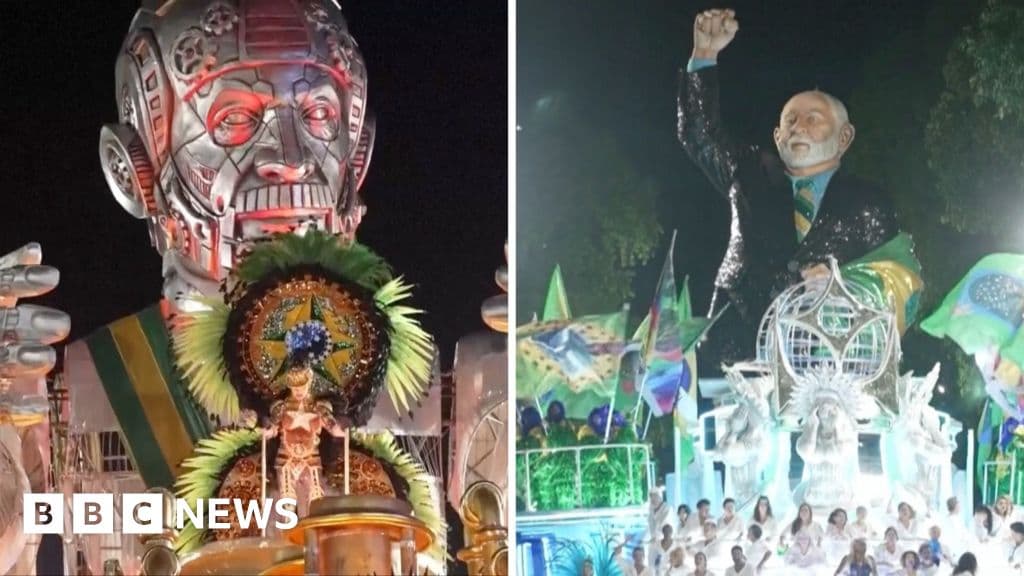
Rio de Janeiro’s iconic Sambadrome exploded into a kaleidoscope of colour and steel as the 2026 Carnival parades commenced with a thunderous tribute to President Luiz Inácio Lula da Silva. In a spectacle that blurred the lines between high art and political theatre, a towering, articulated robot depicting the President served as the centrepiece, symbolizing his mechanical determination and his dramatic ascent from poverty to the pinnacle of Brazilian power.
The night air in Rio was thick with humidity and anticipation as the Gaviões da Fiel samba school entered the avenue. For millions of Brazilians, this was not merely a parade; it was a coronation of resilience. The float, a marvel of modern engineering standing over 15 metres tall, featured a mechanized Lula, his arm raised in a perpetual wave to the adoring masses. The symbolism was potent: a man who had faced imprisonment and political exile, now reimagined as an unstoppable force, a "Robo-Lula" guiding the nation through its complex post-recession recovery.
But why does this matter now, and what does it signal for the global south? The carnival, often dismissed by international observers as a mere hedonistic party, is in reality Brazil's most powerful cultural export and a barometer of its social soul. By placing a sitting President—and a polarizing one at that—at the heart of the festivities, the samba schools are making a definitive statement about the country's direction. It is a rejection of the apathy that plagued the previous decade and an embrace of a muscular, industrial optimism.
The craftsmanship involved in the tribute was nothing short of revolutionary. Unlike the papier-mâché giants of yesteryear, this year's floats incorporated animatronics and LED projection mapping, reflecting Brazil's growing tech sector. The Lula robot did not just stand; it moved with a fluidity that unsettled and mesmerized in equal measure.
For the Kenyan observer, the parallels are striking. Just as Nairobi’s matatu culture serves as a moving canvas for political and social commentary, Rio’s floats are the editorials of the street. They speak truth to power, or in this case, power to the people. The decision to mechanize Lula suggests a leader who is seen not just as a man, but as a system—a necessary machine for the functioning of the state.
Beyond the glitter, the economics of this year's Carnival are staggering. Rio officials estimate the festival will inject over $1 billion (approx. KES 130bn) into the local economy. Hotels are at 98% occupancy, and the informal sector—the street vendors selling *caipirinhas* and skewers—is seeing a boom that rivals the pre-pandemic golden years.
This economic injection is vital. Brazil, like many emerging markets including Kenya, battles with high inflation and income inequality. The Carnival is a redistribution mechanism, funneling tourist dollars from the wealthy beachfronts of Copacabana to the *favelas* where the samba schools are born and bred. The "Lula Robot" is not just a statue; it is a totem of this economic engine, representing the Workers' Party's focus on lifting the base of the pyramid.
While Rio dances, the eyes of the Global South are watching. Brazil’s ability to turn cultural heritage into a billion-dollar asset offers a blueprint for East African nations. Kenya’s cultural festivals, while vibrant, have yet to achieve the industrial-scale monetization seen in the Sambadrome. The integration of technology—robotics, lighting, and sound—into traditional celebrations is a frontier waiting to be explored by Nairobi’s creatives.
Moreover, the political confidence on display is a lesson in soft power. Brazil is asserting its identity on the world stage, unapologetically canonizing its living leaders. It begs the question: how do we honour our own narratives? Do we wait for history books, or do we paint them in bold colours on our streets?
As the sun rose over the Guanabara Bay, the giant robot was finally dismantled, its metal skeleton revealed. But the message remained intact. Lula’s Brazil is not hiding. It is marching, dancing, and engineering its way into the future.
"The carnival is the only time the people are truly the masters of the street," remarked one masquerader, wiping glitter from his brow. "And tonight, the giant walked with us."
Keep the conversation in one place—threads here stay linked to the story and in the forums.
Sign in to start a discussion
Start a conversation about this story and keep it linked here.
Other hot threads
E-sports and Gaming Community in Kenya
Active 9 months ago
The Role of Technology in Modern Agriculture (AgriTech)
Active 9 months ago
Popular Recreational Activities Across Counties
Active 9 months ago
Investing in Youth Sports Development Programs
Active 9 months ago