We're loading the full news article for you. This includes the article content, images, author information, and related articles.
A year of relentless pro-EU demonstrations in Tbilisi offers a stark case study for nations like Kenya on the high-stakes geopolitical tug-of-war between Western democratic alignment and resurgent Russian influence.
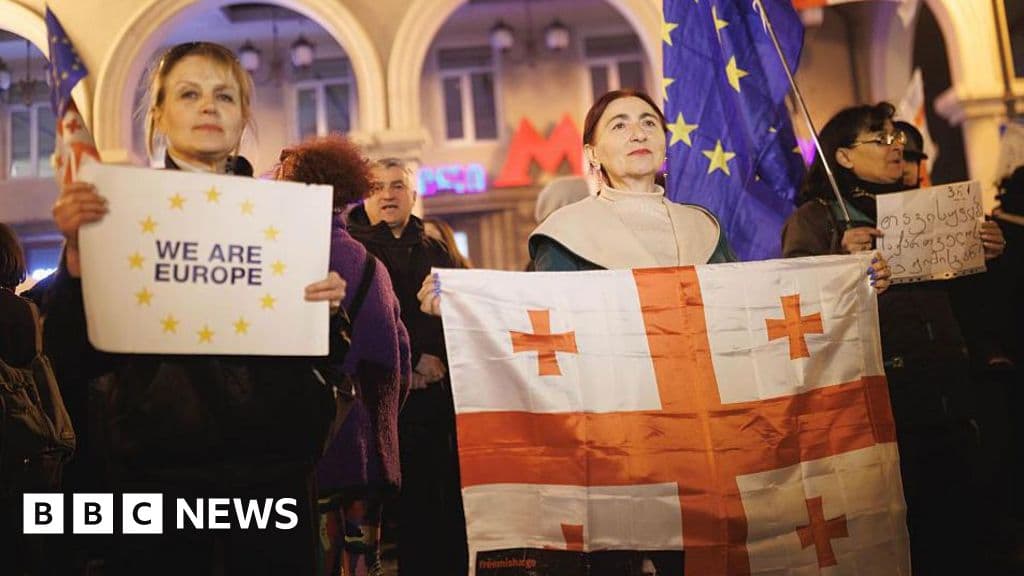
TBILISI, GEORGIA – For 365 consecutive days, the streets of Georgia's capital have echoed with the chants of citizens demanding a European future, marking a grim anniversary in the nation's political history. On Thursday, 28 November 2025 EAT, exactly one year will have passed since Prime Minister Irakli Kobakhidze and his ruling Georgian Dream party announced they would halt the country's European Union accession process until at least 2028. The decision, which the government claimed was to pursue membership with "dignity" and resist "blackmail" from Brussels, ignited a sustained protest movement that continues to challenge the government's westward drift.
"I'm standing for the future of this country," said Giorgi Arabuli, a protester who has been a regular presence on Tbilisi's main Rustaveli Avenue. "We don't want to go back there," he added, referencing the civil strife of the 1990s, which many Georgians associate with Russian interference. His sentiment is shared by tens of thousands who fear the government's actions represent a deliberate pivot back into Moscow's orbit and a systematic "dismantling of democracy."
The government's response to the persistent demonstrations has been severe. Over the past year, peaceful rallies have frequently been met with violent police crackdowns, including the use of water cannons and tear gas. The Georgian Dream-controlled parliament has also passed a series of repressive laws aimed at stifling dissent. These include imposing massive fines for blocking roads and, more recently, legislation allowing for imprisonment for such offenses. Hundreds of protesters have been detained and fined, with total penalties reportedly exceeding 2 million GEL (approximately 700,000 USD). This legislative push follows the controversial "foreign influence" law, passed in mid-2024, which mirrors Russian legislation used to crush civil society and was widely condemned by the EU and the United States as incompatible with European values.
International condemnation has been swift and consistent. The European Union stated that Georgia's accession process is now "de facto halted" due to the government's actions. Similarly, the U.S. State Department announced on 30 November 2024, that it had suspended its strategic partnership with Georgia, citing the government's anti-democratic trajectory as a violation of the alliance's core principles.
While Georgia may seem geographically distant, its struggle offers a potent and relevant analysis for Kenya and the wider East African region. The events in Tbilisi are a textbook example of a nation caught in the geopolitical contest between the democratic, values-based framework of the West and the sphere of influence asserted by powers like Russia. Moscow has long used a combination of economic pressure, disinformation, and political co-optation to undermine Georgia's Euro-Atlantic ambitions.
This dynamic is not unfamiliar to Kenya, which navigates its own complex relationships with global superpowers, including the EU, the U.S., and China. The European Union is Kenya's second-largest trading partner and most important export market, with total trade reaching €3 billion in 2023. The recently signed EU-Kenya Economic Partnership Agreement (EPA) is explicitly built on a foundation of shared values, including sustainable development, labour rights, and democratic stability. This agreement, described as the most ambitious the EU has signed with a developing nation, underscores that for Brussels, trade and democratic governance are deeply intertwined.
Georgia's experience serves as a cautionary tale: a government's pivot away from democratic norms can jeopardize these crucial economic and strategic partnerships. The ruling Georgian Dream party's narrative—accusing the West of fomenting revolution and infringing on national sovereignty—is a tactic often deployed to justify authoritarian consolidation. For East African nations, where civil society and independent media are vital for accountability, the Georgian case highlights the critical importance of safeguarding democratic institutions against both internal and external pressures that seek to erode them.
As protesters in Tbilisi prepare to mark the one-year anniversary of their movement, their defiance is more than a domestic issue. It is a powerful demonstration of a people's will to choose their geopolitical destiny—a struggle that resonates with all nations striving to maintain sovereignty and democratic integrity in an increasingly polarized world.
Keep the conversation in one place—threads here stay linked to the story and in the forums.
Sign in to start a discussion
Start a conversation about this story and keep it linked here.
Other hot threads
E-sports and Gaming Community in Kenya
Active 9 months ago
The Role of Technology in Modern Agriculture (AgriTech)
Active 9 months ago
Popular Recreational Activities Across Counties
Active 9 months ago
Investing in Youth Sports Development Programs
Active 9 months ago



