We're loading the full news article for you. This includes the article content, images, author information, and related articles.
In a dusty garage in Nairobi, a woman who once took the Hippocratic Oath now diagnoses transmission failures instead of patients. Joan Nyambura’s radical career pivot from medicine to mechanics is not just a personal journey—it is a stinging indictment
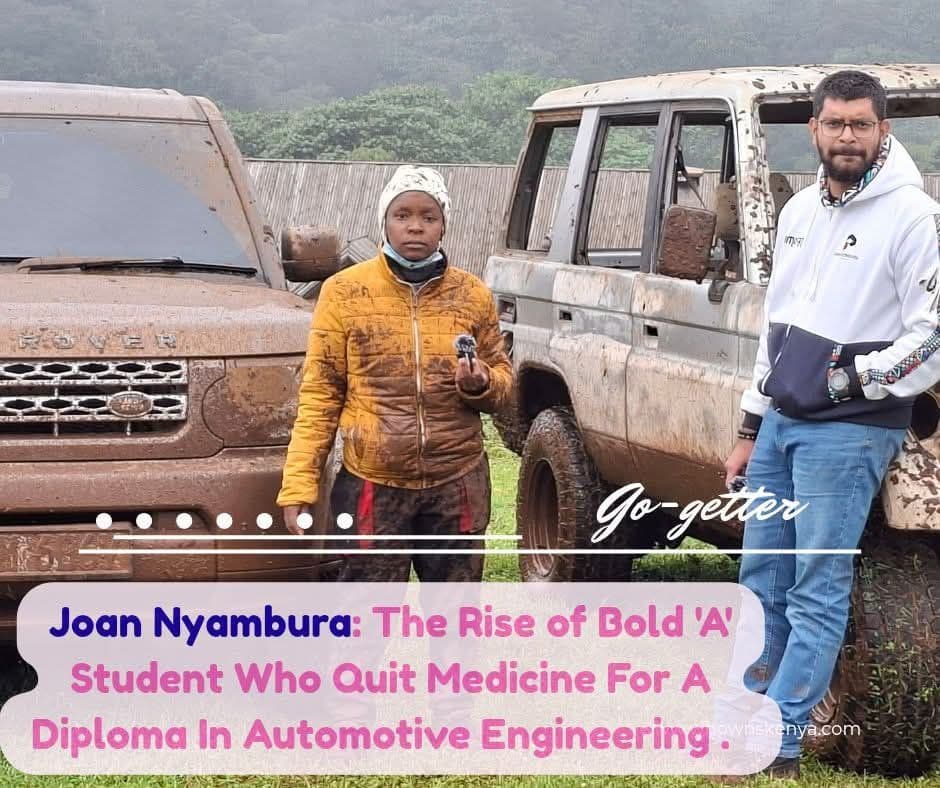
In a dusty garage in Nairobi, a woman who once took the Hippocratic Oath now diagnoses transmission failures instead of patients. Joan Nyambura’s radical career pivot from medicine to mechanics is not just a personal journey—it is a stinging indictment of the white-collar obsession that plagues Kenya’s education system.
The air at Precision Automotive on Nairobi’s bustling industrial fringe smells of grease, burnt rubber, and the metallic tang of grinding gears. It is a far cry from the sterile, antiseptic corridors of a teaching hospital, where Joan Nyambura spent her formative years training to be a doctor. Today, clad in oil-stained blue overalls, the founder of 4Real Ke is deep inside the engine bay of a Subaru Forester, her hands moving with the same surgical precision she once used to suture wounds.
“The engine doesn’t lie,” Nyambura says, wiping a smear of oil from her forehead. “Patients can lie about their symptoms. They can hide their pain. But a piston? A spark plug? They tell you exactly what is wrong if you know how to listen.”
Nyambura’s story, captured vividly by Business Daily, is a narrative disruptor in a country where "Daktari" (Doctor) is a title of supreme social currency. For decades, the Kenyan middle-class dream has been rigidly defined: study hard, get a degree in medicine, law, or engineering, and secure a life of comfort. Nyambura followed the script perfectly, until she didn’t.
“I felt like I was living someone else’s life,” she admits. The transition was not sudden but a slow burn of dissatisfaction. While her peers were memorizing anatomy textbooks, Nyambura found herself drawn to the mechanical anatomy of the vehicles in the hospital parking lot. The complexity of an internal combustion engine fascinated her in a way the human circulatory system never did.
Her decision to hang up her stethoscope was met with shock, and in some quarters, disdain. In Kenya’s conservative social hierarchy, trading a white coat for a mechanic’s overall is seen as a regression—a descent from the professional class to the Jua Kali (informal) sector. But Nyambura saw a market gap that the elites had missed: trust.
The Kenyan used car market is a minefield of fraud. Odometer tampering, concealed accident history, and cut-and-join chassis are rampant. Nyambura founded 4Real Ke to bring clinical rigor to this chaotic industry. Her business model is simple but revolutionary: a pre-purchase inspection service that offers a "medical report" for vehicles.
“We treat every car like a patient,” she explains. Her team performs a 150-point check, covering everything from compression ratios to suspension integrity. The reports are detailed, transparent, and non-negotiable. In an industry built on opacity, Nyambura is selling the most valuable commodity of all: peace of mind.
Nyambura’s success challenges the rigidity of Kenya’s education system, which pumps out thousands of graduates into a saturated job market while technical fields scream for skilled labor. The government’s push for TVET (Technical and Vocational Education and Training) has often been met with apathy by youth who view manual labor as undignified. Nyambura is the poster child for the counter-argument: that blue-collar work, when professionalized, can be both lucrative and fulfilling.
“We need to stop telling our children that success looks like a desk,” she argues. “Success is solving a problem. And right now, Nairobi has a lot of broken cars.”
As the sun sets over the industrial area, the garage is still buzzing. Nyambura is finalizing a report for a client who almost bought a flood-damaged Toyota. She is tired, her nails are black with grime, but she is smiling. She may not be saving lives in the traditional sense, but she is saving livelihoods, one inspection at a time.
In a nation hungry for integrity, Joan Nyambura has built a business empire with a wrench in one hand and a diagnostic tablet in the other. She proves that sometimes, the best way to fix the world is to get your hands dirty.
Keep the conversation in one place—threads here stay linked to the story and in the forums.
Sign in to start a discussion
Start a conversation about this story and keep it linked here.
Other hot threads
E-sports and Gaming Community in Kenya
Active 9 months ago
The Role of Technology in Modern Agriculture (AgriTech)
Active 9 months ago
Popular Recreational Activities Across Counties
Active 9 months ago
Investing in Youth Sports Development Programs
Active 9 months ago