We're loading the full news article for you. This includes the article content, images, author information, and related articles.
Following a stinging rebuke from Washington, Europe’s top brass engages the White House to salvage a peace deal that could reshape global stability.
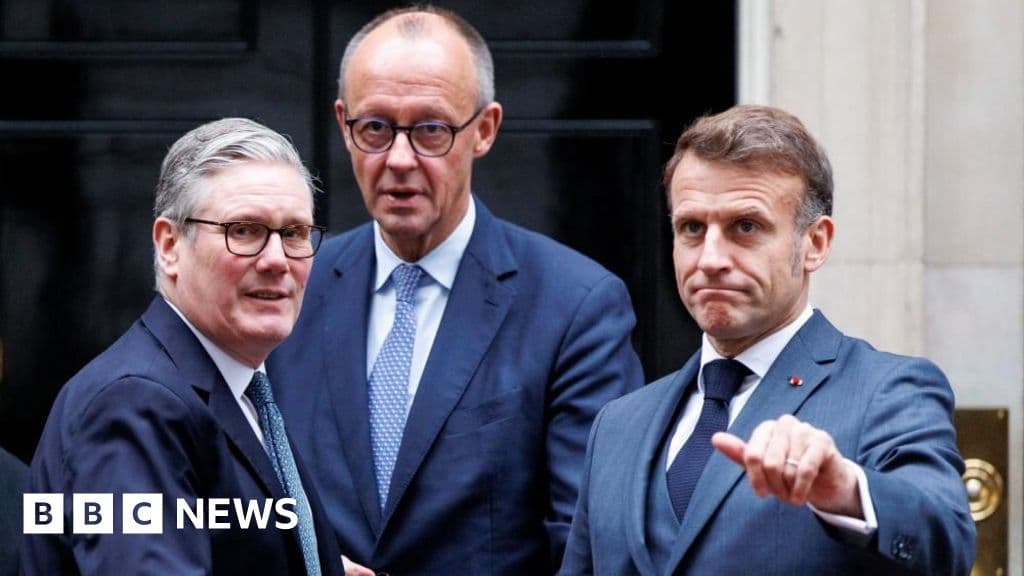
The diplomatic phone lines between Europe and Washington are burning hot this morning as Western powers race to finalize a US-led roadmap to end the war in Ukraine. Following a high-stakes joint call with US President Donald Trump, European leaders have confirmed that "intensive work" will dominate the coming days.
For Kenyans watching from thousands of miles away, the stakes of this high-wire act are far from abstract. The conflict in Eastern Europe has long acted as a volatile variable in the global economy, directly influencing the cost of fuel at the pump and the price of wheat imports that determine the cost of living in Nairobi.
The joint conversation involved UK Prime Minister Sir Keir Starmer, French President Emmanuel Macron, and German Chancellor Friedrich Merz. In a rare display of unified messaging, the trio emphasized that they "agreed that this was a critical moment—for Ukraine, its people and for shared security across the Euro-Atlantic region."
However, the diplomatic language barely conceals the friction simmering beneath the surface. The call occurred just 24 hours after President Trump publicly branded European leaders as "weak" in a wide-ranging interview, hinting that American support for Kyiv could be scaled back if progress isn't made.
Trump characterized the discussion with his signature bluntness. He admitted there were "some little disputes about people," noting that they "discussed Ukraine in pretty strong words."
Beyond the battlefield, political maneuvering has taken center stage. In his interview with Politico on Tuesday, Trump alleged that Ukraine was "using war" as a pretext to avoid holding democratic elections. This prompted a swift rebuttal from Ukrainian President Volodymyr Zelensky, who declared he was "ready" to face the electorate.
The current state of play remains grim:
While the geopolitics play out in Brussels and Washington, the economic ripples are felt in East Africa. A stable resolution to the conflict could ease global supply chain disruptions, potentially stabilizing the Kenya Shilling (KES) against the dollar by reducing global market volatility.
As the "intensive work" continues behind closed doors, the world holds its breath, waiting to see if this diplomatic gamble brings a definitive peace or merely redraws the battle lines for the next phase of conflict.
Keep the conversation in one place—threads here stay linked to the story and in the forums.
Other hot threads
E-sports and Gaming Community in Kenya
Active 9 months ago
The Role of Technology in Modern Agriculture (AgriTech)
Active 9 months ago
Popular Recreational Activities Across Counties
Active 9 months ago
Investing in Youth Sports Development Programs
Active 9 months ago