We're loading the full news article for you. This includes the article content, images, author information, and related articles.
The European Parliament has suspended a key US trade deal in protest of Donald Trump’s demand to acquire Greenland, sparking fears of a renewed trade war.
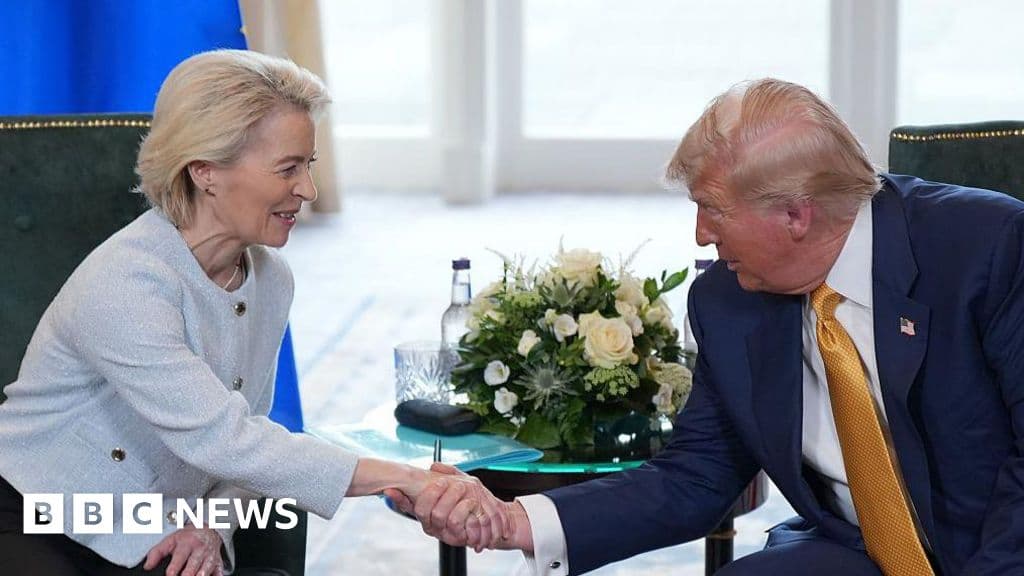
The European Parliament has officially frozen the ratification of a landmark trade agreement with the United States, throwing transatlantic relations into a deep freeze following President Donald Trump’s audacious ultimatum to acquire Greenland.
The suspension, announced in Strasbourg this Wednesday, marks a dramatic collapse of the "Turnberry Truce" brokered just last July. What began as a diplomatic whisper has roared into a full-blown geopolitical crisis, with Brussels drawing a red line in the ice: Europe’s sovereignty is not for sale, and the price of American friendship cannot be the territorial integrity of Denmark. This move effectively dares the White House to execute its threat of punitive tariffs, signaling a volatile new chapter in global trade.
The catalyst for this unprecedented rupture was President Trump’s address at the World Economic Forum in Davos earlier today. While he stopped short of threatening military force—a clarification that did little to calm nerves—his "proposal" was stark: the US seeks "immediate negotiations" for the purchase of Greenland, citing its strategic importance against Russian and Chinese influence in the Arctic.
More alarmingly for European lawmakers, the President explicitly linked this real estate ambition to trade policy. The administration has threatened to slap a 10% tariff on goods from eight European nations, escalating to a crippling 25% by June, if the "Greenland Question" is not resolved in Washington’s favor.
The sentiment in Strasbourg was one of rare unity. Lawmakers from across the political spectrum rallied behind Denmark. The deal, which would have required the EU to slash import duties on American goods to boost US exports, was already controversial. Trump’s linkage of tariffs to the acquisition of the world’s largest island provided the perfect political cover to kill it.
"This is about more than tariffs," said a senior EU diplomat speaking on condition of anonymity. "If we yield on Greenland today, what will be the asking price tomorrow? The Azores? This is a test of the European project's spine."
As the US President continues his meetings in Davos, the ball is firmly back in Washington’s court. But with the 2026 midterms looming in the US, and Trump doubling down on his "Manifest Destiny of the North," a de-escalation seems unlikely. The transatlantic bridge hasn't just been burned; it’s been dynamited.
Keep the conversation in one place—threads here stay linked to the story and in the forums.
Sign in to start a discussion
Start a conversation about this story and keep it linked here.
Other hot threads
E-sports and Gaming Community in Kenya
Active 9 months ago
The Role of Technology in Modern Agriculture (AgriTech)
Active 9 months ago
Popular Recreational Activities Across Counties
Active 9 months ago
Investing in Youth Sports Development Programs
Active 9 months ago



