We're loading the full news article for you. This includes the article content, images, author information, and related articles.
Gated estates are reshaping Nairobi’s growth. Do they raise property values or create urban divides? A deep, research-backed look at Kiambu Road and beyond.
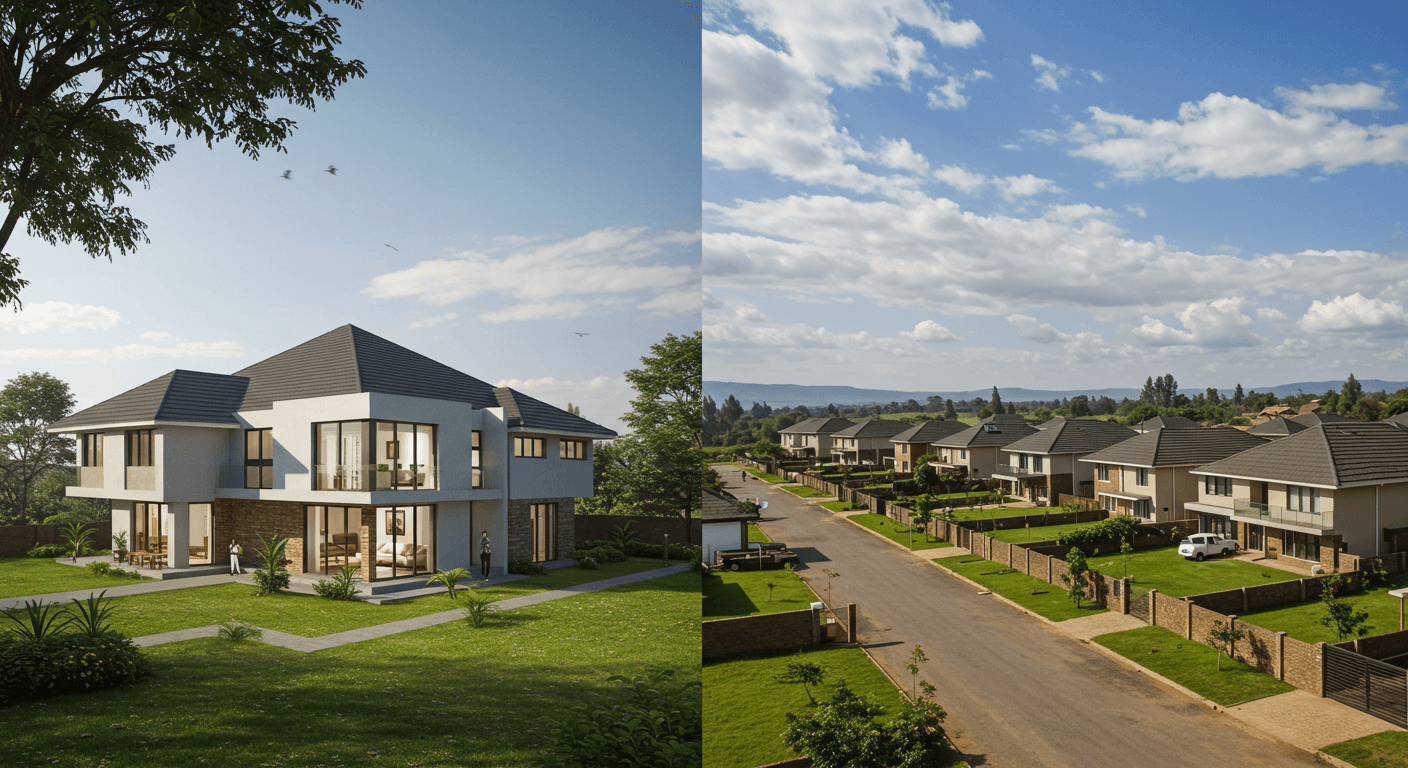
Nairobi–Kiambu Corridor, Kenya — 2026
Along Nairobi’s northern edge, a quiet but consequential shift is unfolding. As roads expand, institutions cluster, and land values rise, housing is no longer evolving as one continuous fabric. It is splitting—into two parallel systems.
One is open, shared, and publicly governed.
The other is enclosed, privately managed, and increasingly self-contained.
This is not just a housing trend. It is an urban restructuring.
And nowhere is this tension more visible than along the Kiambu Road corridor.
Urban research on Nairobi has consistently pointed to a pattern of residential fragmentation—where the city develops in distinct pockets with unequal access to infrastructure, services, and quality of life.
Gated developments sit at the center of this shift.
They are not simply about security or exclusivity. They represent a different model of urban living—one built on:
Private governance
Controlled access
Self-managed services
At the same time, public infrastructure continues to shape where and how these developments emerge.
The Kenyan government’s confirmed dualling of the Muthaiga–Kiambu–Ndumberi Road (23.5 km) is one such catalyst. Improved mobility does not just reduce travel time—it reshapes demand, often accelerating development and replication of what appears to work.
The key question is no longer whether gated estates are desirable.
It is:
Who benefits—and who absorbs the cost?
Gated estates often operate on limited supply and controlled environments. This creates a scarcity effect, which can support higher property values—especially in areas where security and privacy are priorities.
In a city where public service delivery can vary, well-managed estates offer:
Consistent maintenance
Waste management systems
Landscaped environments
Enforced community standards
For many buyers, this predictability is a primary driver—not an added bonus.
Gated communities generate demand for services such as:
Security
Cleaning and maintenance
Landscaping
Deliveries and domestic support
These micro-economies can be significant, though their long-term stability depends on governance and fair contracting practices.
As gated developments increase, the city becomes more segmented. Research on Nairobi shows that such separation can lead to unequal living conditions and reduced interaction across communities.
Over time, this can weaken the urgency to improve shared public infrastructure.
While benefits are internalised, impacts often spill outward:
Increased traffic congestion
Construction disruption
Drainage and environmental strain
Without strong oversight, private development can create public burdens.
As premium enclaves expand, land values can rise faster than local income levels—reshaping who can live in the area and pushing demand into less regulated zones.
To understand how this plays out in practice, it helps to look at how specific developments are positioning themselves within changing corridors.
37BYINEZA—located behind Runda along Kwaheri Road off Kiambu Road—offers a clear example of the “controlled enclave” approach emerging in response to rising density pressure.
With 37 homes across approximately 5 acres, the development is deliberately structured as low-density within a corridor that is gradually intensifying.
This is not incidental. It is strategic.
As Kiambu Road evolves, projects like this are effectively making a bet:
That long-term value will come not from density—but from resisting it.
In practical terms, this model aims to:
Preserve space and quiet within a growing urban corridor
Maintain predictable internal governance
Create a buffer from external pressures such as congestion and uncoordinated development
But it also raises a broader question:
If more developments adopt this model, does the corridor become:
A collection of well-managed private islands
Or a balanced urban environment where both private and public spaces improve together?
The outcome will depend not just on developers—but on infrastructure planning, enforcement, and civic accountability.
Kiambu Road is no longer a single identity market. It is evolving into a split corridor:
Inner zones (closer to Gigiri/Runda):
Lower density, controlled development, premium positioning
Outer zones:
Increasing density, mixed planning quality, rising congestion
Infrastructure upgrades—such as the Muthaiga–Kiambu–Ndumberi dualling—will likely accelerate both ends of this spectrum.
The risk is not growth itself.
It is unbalanced growth.
Demand construction impact plans (noise, dust, truck routing)
Monitor drainage and traffic patterns
Push for clear communication channels with developers
Treat “gated living” as a governance contract, not a lifestyle label.
Ask for:
Service charge structure and long-term sustainability
Rules enforcement mechanisms
Security protocols and management systems
Defects liability and handover clarity
And verify all approvals independently.
Enforce development standards that limit spillover impact
Strengthen shared infrastructure (roads, drainage, lighting)
Ensure corridor growth benefits the wider public—not just enclosed developments
Gated developments are not inherently the problem.
They are a response—to gaps in security, service delivery, and urban management.
But if they become the dominant model without parallel investment in public systems, Nairobi risks becoming:
Efficient in parts
Fragmented as a whole
Developments like 37BYINEZA are not just homes. They are signals—of where demand is moving, what buyers are prioritising, and how the city’s residential map is being redrawn in real time.
The real question is whether that map will remain connected—or divided by design.
Keep the conversation in one place—threads here stay linked to the story and in the forums.
Sign in to start a discussion
Start a conversation about this story and keep it linked here.
Other hot threads
E-sports and Gaming Community in Kenya
Active 9 months ago
The Role of Technology in Modern Agriculture (AgriTech)
Active 9 months ago
Popular Recreational Activities Across Counties
Active 9 months ago
Investing in Youth Sports Development Programs
Active 9 months ago