We're loading the full news article for you. This includes the article content, images, author information, and related articles.
Death Valley in California - the hottest place on Earth and the driest place in North America - is currently carpeted in wildflowers in what is shaping up to be the best bloom in a decade. The National Park Service (NPS) officially categorised this as an above-average bloom year on 22 February.
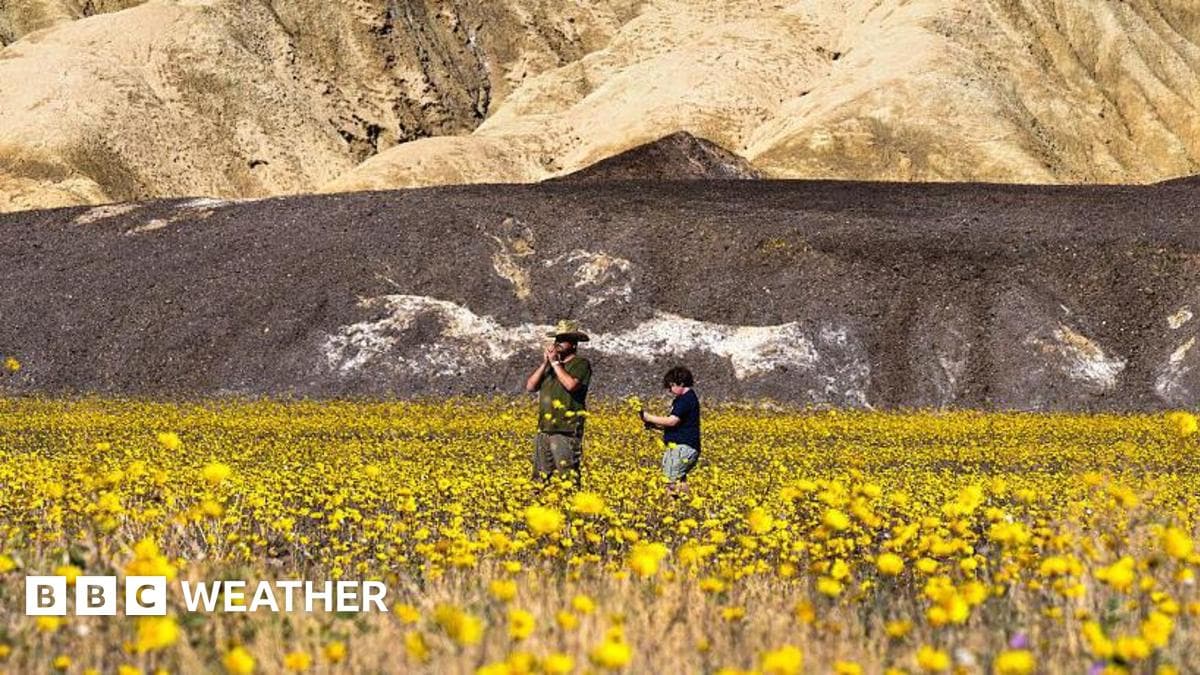
In the parched heart of California, where temperatures regularly flirt with the limits of human survival, a vivid insurrection of color has broken out. Across the desolate floor of Death Valley National Park, a rare, transient tapestry of gold and violet has emerged, signaling the most significant wildflower bloom in a decade. The spectacle, which has drawn scientists and tourists alike to the Mojave Desert, offers a startling counter-narrative to the region's reputation as the driest, hottest place in North America.
This is not merely a aesthetic spectacle it is a profound ecological response to a dramatic shift in meteorological patterns. After years of punishing drought, the record rainfall of autumn 2025—totaling 2.41 inches (6.1 centimeters)—has unlocked a subterranean seed bank that has waited years, and in some cases decades, for the right conditions to germinate. For climate scientists, this event provides a critical, real-time case study in how desert ecosystems respond to extreme, climate-induced volatility. It challenges our understanding of desert dormancy and highlights the delicate tipping point between a barren landscape and a thriving, ephemeral ecosystem.
To understand the biological marvel occurring in Death Valley, one must look at the chemistry of the seeds themselves. Desert annuals in this region have evolved a sophisticated survival mechanism: germination inhibitors. These chemical coatings protect the seeds from sprouting during light, insignificant showers that would not provide enough moisture for the plant to complete its lifecycle. The seeds sit in wait, dormant, for a specific, threshold-crossing volume of water to wash away these chemical inhibitors.
The autumn rains of 2025 acted as a mass biological trigger. When the precipitation levels hit the specific mark required to dissolve these inhibitors, the desert floor underwent a metamorphosis. This is not simply a matter of adding water it is a precise biological equation. Without the correct volume of moisture, the seeds remain locked in their dry, dormant state. Once unlocked, the seeds must compete for nutrients in an environment where soil quality is often marginal and the threat of rapid evaporation is constant.
The current bloom is being measured against the monumental 2016 superbloom, an event that became a benchmark for desert ecology. While comparisons are frequent, park officials caution that the two events are unique in their variables. The 2016 bloom benefited from a specific sequence of late-summer storms followed by steady, moderate winter temperatures that allowed for a protracted growth period. The 2026 event, while impressive, faces its own distinct challenges regarding soil temperature and wind patterns.
The intensity of the current bloom serves as a reminder of the climate volatility defining this decade. While visitors celebrate the visual richness, botanists are meticulously documenting the density of the flowers to assess the health of the seed bank for future cycles. There is a palpable concern that should climate change patterns force these "superbloom" events to become either too frequent or too sparse, the evolutionary rhythm of these species could be permanently disrupted.
While Death Valley is thousands of kilometers from the arid lands of East Africa, the biological mechanisms at play are strikingly similar to the regenerative cycles seen in Kenya’s Arid and Semi-Arid Lands (ASALs). In regions like Turkana, Marsabit, and Mandera, the arrival of rain after a prolonged drought often triggers a similar, albeit functionally different, awakening of the landscape. For Kenyan pastoralists and conservationists, the "greening" of the desert is a matter of immediate economic and existential survival, whereas in Death Valley, it is primarily a subject of scientific and recreational interest.
The lessons are transferable. Both environments rely on highly adapted, resilient vegetation that utilizes dormant states to survive extreme aridity. Kenyan agricultural experts and rangeland managers, who have studied the management of vegetation in water-stressed environments, often cite the importance of soil moisture retention and the protection of native grasses, much like the National Park Service in the United States protects wildflower habitats from vehicular compaction and trampling. The connection is clear: desertification is a global challenge, and the ability of an ecosystem to "bounce back" is a critical indicator of regional environmental health.
The influx of visitors creates a significant, unintended consequence for the park: the pressure of human impact. In the age of social media, the allure of a rare "superbloom" acts as a powerful magnet, leading to thousands of visitors attempting to access remote, fragile areas. The National Park Service has had to implement aggressive trail management and educational campaigns to prevent tourists from walking off-trail, which causes soil compaction that can destroy the subterranean seed banks for future years.
The challenge for authorities is to balance the public's desire to witness nature's resilience with the necessity of ensuring that this resilience is not destroyed by the very people who come to admire it. As the blooms persist through mid-to-late March, the delicate desert floor remains a site of both scientific triumph and significant logistical strain. Whether this vibrant display is a sign of long-term ecological stability or a fleeting reaction to an anomaly remains the core question for researchers monitoring the basin.
As the desert gold fades and the season moves toward the higher elevations in the coming months, the event serves as a poignant reminder that life in the extreme is never static. It is a constant, patient waiting game—a testament to the fact that even in the harshest environments on Earth, the potential for life is never truly extinguished it is merely waiting for the rain.
Keep the conversation in one place—threads here stay linked to the story and in the forums.
Sign in to start a discussion
Start a conversation about this story and keep it linked here.
Other hot threads
E-sports and Gaming Community in Kenya
Active 9 months ago
The Role of Technology in Modern Agriculture (AgriTech)
Active 9 months ago
Popular Recreational Activities Across Counties
Active 9 months ago
Investing in Youth Sports Development Programs
Active 9 months ago



