We're loading the full news article for you. This includes the article content, images, author information, and related articles.
The High Court has declared President William Ruto's task force for compensating protest victims unconstitutional, affirming the mandate belongs to the Kenya National Commission on Human Rights.
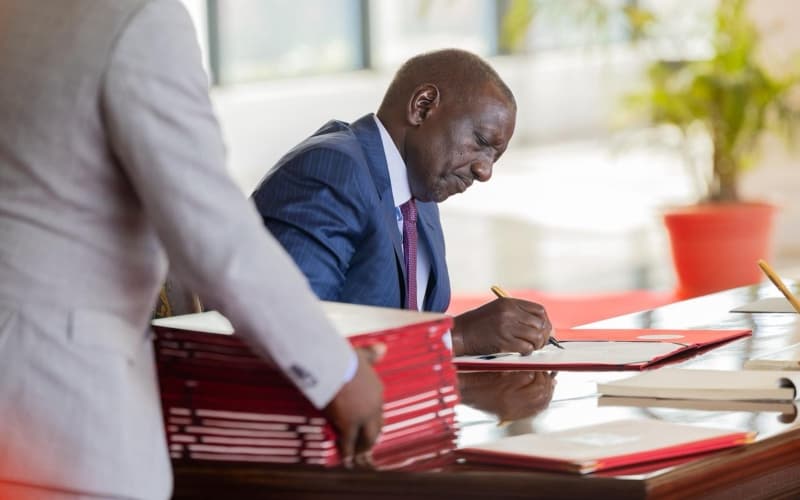
The High Court on Thursday dealt a significant blow to a presidential initiative, declaring the establishment of a panel to compensate victims of protest-related violence unconstitutional. In a landmark decision, the court affirmed that the mandate to handle reparations and victim compensation lies exclusively with the Kenya National Commission on Human Rights (KNCHR), not the executive.
This ruling effectively halts the operations of the 18-member 'Presidential Panel of Experts on Compensation of Victims of Demonstrations and Public Protests,' which was established via a gazette notice on August 25, 2025. The judgment answers a critical question about the separation of powers and the proper channels for addressing state-related human rights violations, a recurring issue for many Kenyan families seeking justice and closure.
The court's decision validates the position long held by the KNCHR and various civil society groups. In its filings, the KNCHR had termed the President's panel "irregular and illegal," arguing it duplicated its constitutional functions and risked wasteful expenditure of public funds. The commission noted a stark overlap in the mandates, including the verification of victims, designing compensation frameworks, and proposing police reforms.
In its judgment, the court was unequivocal, stating, “The President is not constitutionally empowered to constitute a panel of experts to advise on the compensation of victims of protests. The same lies with the competent body- KNCHR.” The ruling emphasized that while the President has a duty to protect human rights, this must be exercised through legally established institutions.
For the hundreds of Kenyans awaiting redress for police brutality and other violations during recent anti-government protests, this ruling redirects their hope towards the KNCHR. The court has ordered the state to hand over any reports or findings from the now-voided panel to the KNCHR within 30 days. Failure to comply would lead to the formal quashing of the panel's establishment.
The decision also brings into focus the broader challenge of state accountability and the long wait for justice that many victims of historical injustices have endured. This includes delays in the operationalization of a KES 10 billion (approx. $76.9 million) Restorative Justice Fund announced by former President Uhuru Kenyatta in 2015, which has yet to be fully implemented.
The court has placed the responsibility squarely on the KNCHR to “take steps to secure appropriate redress where redress is required.” This puts the human rights body, often seen as under-resourced, under immense pressure to deliver for victims who have waited for years. The ruling serves as a crucial test for the independence and capacity of Kenya's constitutional commissions in the face of executive action.
While the Attorney General's office has yet to issue a formal response to the ruling, the decision is a pivotal moment in the ongoing struggle for human rights and restorative justice in Kenya. The focus now shifts to the KNCHR and whether it will receive the necessary state support to fulfill the mandate the High Court has so forcefully reaffirmed.
Keep the conversation in one place—threads here stay linked to the story and in the forums.
Sign in to start a discussion
Start a conversation about this story and keep it linked here.
Other hot threads
E-sports and Gaming Community in Kenya
Active 9 months ago
The Role of Technology in Modern Agriculture (AgriTech)
Active 9 months ago
Popular Recreational Activities Across Counties
Active 9 months ago
Investing in Youth Sports Development Programs
Active 9 months ago



