We're loading the full news article for you. This includes the article content, images, author information, and related articles.
Client etiquette for companions in discreet, high-trust environments: communication discipline, punctuality, boundaries, venue choices, and professionalism—why these standards protect time, reputation, and repeat engagements.
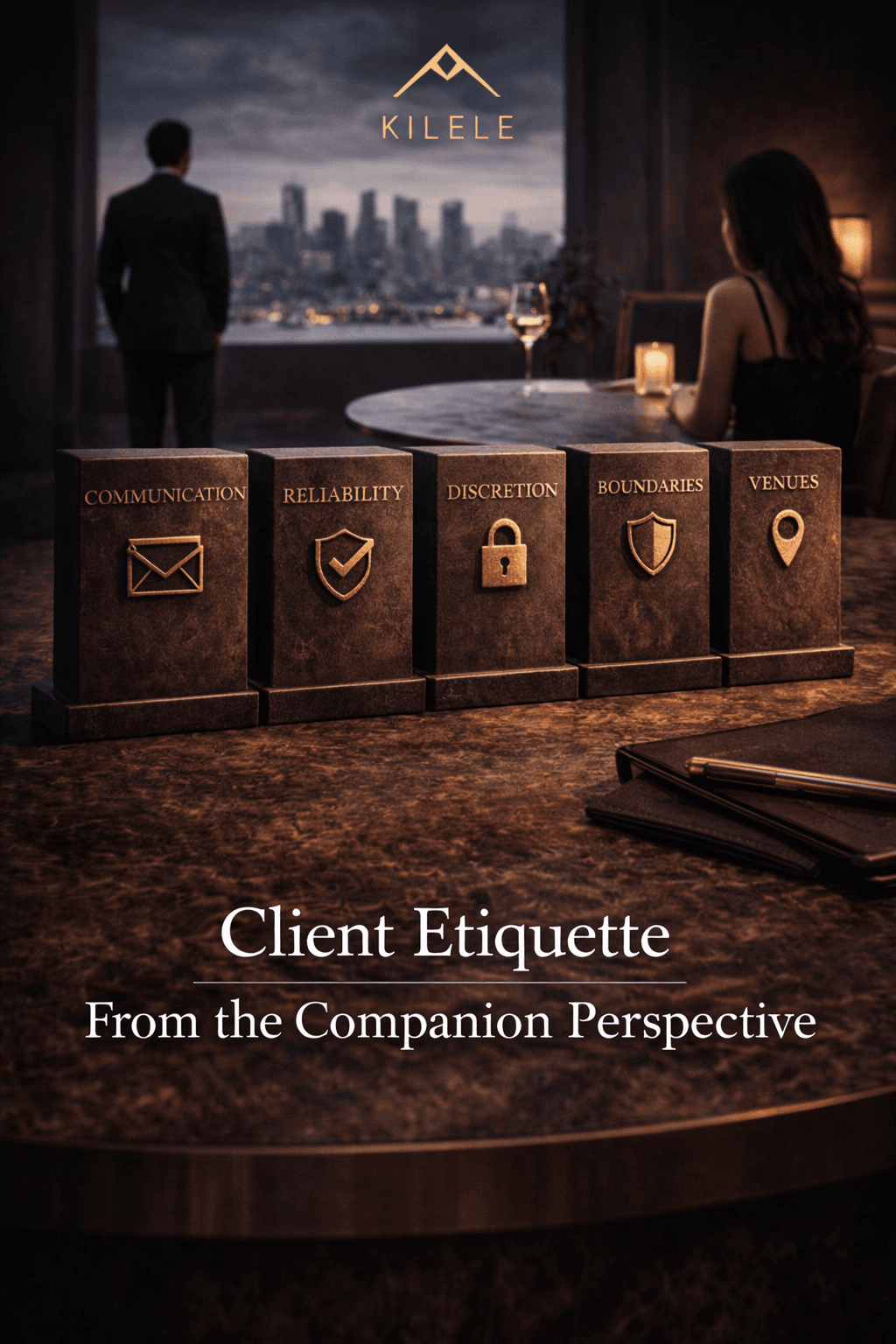
In high-trust environments, etiquette is not personality. It is operational discipline. Clients who operate at founder, executive, or diaspora-professional level do not evaluate companions purely on charm or conversation. They evaluate on predictability: how you communicate, how you coordinate, how you contain risk, and how you protect discretion without being asked. The strongest signal you can send is not glamour. It is stability.
Professionalism is the differentiator.
Most coordination failures do not come from “bad clients” or “difficult companions.” They come from informal habits carried into a context that cannot tolerate noise. Over-messaging. Unclear confirmations. Late arrivals framed casually. Public-facing visibility. Shifting terms mid-flow. These patterns create friction, then exposure, then reputational concern. For high-level clients, friction is already a disqualifier—exposure is permanent. The result is predictable: fewer repeat engagements, more cancellations, and a general tightening of trust.
From the companion perspective, etiquette begins before a meeting is ever confirmed. It starts with how you manage entry.
A discreet standard means your communication is clean and contained. You do not “keep the thread alive” with frequent pings. You confirm what matters, then you go quiet. You avoid emotionally loaded language, avoid ambiguity, and avoid negotiating in public channels. You ask precise questions only when necessary: time window, venue type, tone of engagement, boundaries, and any logistics that protect both sides. The goal is to reduce variables, not add conversation.
Reliability is the next signal. Punctuality is not politeness—it is respect for a calendar that carries real cost. If something shifts, you communicate early, once, and with a solution. You do not improvise excuses. You do not create uncertainty close to the time. High-trust clients interpret last-minute instability as risk, even when it is unintentional.
Discretion is not secrecy. It is containment. The companion standard is simple: never create traceability where none is needed. Do not post hints. Do not share identifiers. Do not discuss venues, details, or client context with third parties. Do not treat proximity to a high-profile life as content. In this tier, discretion is not a courtesy; it is the baseline requirement for access.
Boundaries are not an awkward topic. They are part of professionalism. The more calmly you can state them, the safer the environment becomes. A companion who can hold boundaries without pressure signals maturity. Equally important: you do not attempt to renegotiate boundaries mid-engagement. You do not “test” limits. You do not reward ambiguity. You keep the lane clear.
Venue discipline matters more than most people admit. A first meeting should be controllable: neutral, well-managed, with clear arrival and departure flow. You avoid environments that escalate unpredictability. You avoid settings that trap either party into extended commitment. Elegance is choosing venues that reduce variance—so the engagement stays composed.
Tone management is also etiquette. Clients in high-pressure roles often want calm—no performance, no interrogation, no volatility. You do not push for personal disclosure. You do not compete for attention. You do not create emotional “hooks” to force closeness. You create ease through restraint. The goal is a high-signal presence that does not demand energy to manage.
On logistics and payouts, professionalism is clarity. You confirm terms before the engagement, not during it. You do not introduce new conditions late. You do not create payment pressure. You avoid turning settlement into a conversation thread. Clean terms and clean confirmations protect both parties and remove leverage from the moment. In this context, calm administration is part of the service.
When something goes wrong—miscommunication, timing issues, a mismatch in expectations—etiquette is how you exit. You keep it quiet. You do not escalate. You do not threaten exposure. You do not argue in channels that create receipts. You close the loop respectfully, with minimal text and maximum containment. High-trust ecosystems remember how you handle friction more than how you handle ease.
A simple scenario illustrates the standard. An executive is in town for 48 hours. Their calendar is compressed and visible risk is real. The companion who communicates cleanly, confirms once, arrives on time, respects boundaries, and keeps discretion default will be remembered as “safe.” The companion who floods messages, shifts plans late, seeks visibility, or creates negotiation in the moment will be remembered as “variance.” In this tier, variance is the enemy.
Client etiquette from the companion perspective is therefore not “being nice.” It is operating like private infrastructure: stable, discreet, and low-noise. Not everyone is built for that standard. Those who are do not need to advertise it. It shows in how they coordinate.
For companions who prefer governed coordination—clear boundaries, disciplined communication, controlled visibility—Kilele is designed around that operating standard. If you align with a discretion-first environment, request a structured onboarding pathway via KILELE.APP.
Quiet conclusion: etiquette is risk control.
Keep the conversation in one place—threads here stay linked to the story and in the forums.
Sign in to start a discussion
Start a conversation about this story and keep it linked here.
Other hot threads
E-sports and Gaming Community in Kenya
Active 9 months ago
The Role of Technology in Modern Agriculture (AgriTech)
Active 9 months ago
Popular Recreational Activities Across Counties
Active 9 months ago
Investing in Youth Sports Development Programs
Active 9 months ago