We're loading the full news article for you. This includes the article content, images, author information, and related articles.
The JSC advertises four vacancies for High Court judges in a push to reduce case backlogs and improve judicial efficiency, inviting top legal minds to apply.
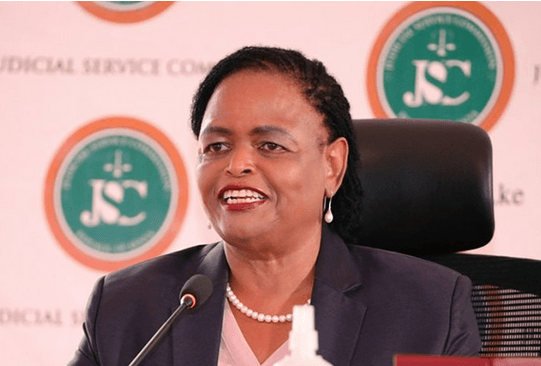
The Judicial Service Commission (JSC) has opened recruitment for four High Court judges, a move aimed at easing the crippling case backlog that continues to strain Kenya’s justice system and test public confidence in the rule of law.
The vacancies, advertised this week, are open to advocates with a minimum of ten years’ post-admission experience. According to the JSC, the search is not merely for seniority, but for individuals who embody “integrity, intellect, and industry” — qualities the commission says are non-negotiable for anyone entrusted with constitutional adjudication.
The recruitment drive comes amid renewed pressure on the judiciary to accelerate case resolution. Chief Justice Martha Koome has repeatedly underscored the need for a “fully staffed bench,” arguing that justice must be delivered in real time, not years after disputes have lost relevance or devastated livelihoods.
Kenya’s judge-to-population ratio remains among the lowest in the region. The consequences are visible across court corridors: civil disputes that linger for decades, criminal trials that stall indefinitely, and commercial cases involving billions of shillings trapped in procedural limbo.
Legal experts warn that the backlog is no longer just a judicial problem — it is an economic one. Delayed resolution of commercial disputes discourages investment, increases the cost of doing business, and undermines Kenya’s ambitions as a regional financial hub.
For ordinary citizens, the impact is deeply personal. Land cases, succession disputes, and employment claims often stretch across years, sometimes outliving the litigants themselves. For many, the promise of justice feels increasingly abstract.
The recruitment process itself has become a national event. JSC interviews for top judicial posts are typically conducted in public and broadcast live, turning candidates’ legal reasoning, ethical compass, and personal histories into matters of national debate.
This transparency, while praised, has not been without controversy in past recruitment cycles. Allegations of bias, political influence, and inconsistency have previously clouded judicial appointments. Cognizant of this history, the JSC has pledged a rigorous and transparent process this time around.
Behind the scenes, competition is expected to be fierce. The High Court bench remains one of the most powerful and prestigious platforms in Kenya’s legal system — a gateway to shaping jurisprudence and, potentially, future elevation to the Court of Appeal or Supreme Court.
For advocates eyeing the red robes, the advertisement signals opportunity. For Kenyans waiting — some since as far back as 2015 — it signals hope.
Whether four judges will be enough to meaningfully dent the backlog remains an open question. But the recruitment marks a clear acknowledgment by the judiciary: justice delayed has become justice denied, and the cost of inaction is no longer tenable.
As the interviews loom, the country will be watching — not just who gets appointed, but whether this latest intervention finally translates into faster, fairer justice for Wanjiku and the nation at large.
Keep the conversation in one place—threads here stay linked to the story and in the forums.
Sign in to start a discussion
Start a conversation about this story and keep it linked here.
Other hot threads
E-sports and Gaming Community in Kenya
Active 9 months ago
The Role of Technology in Modern Agriculture (AgriTech)
Active 9 months ago
Popular Recreational Activities Across Counties
Active 9 months ago
Investing in Youth Sports Development Programs
Active 9 months ago