We're loading the full news article for you. This includes the article content, images, author information, and related articles.
In Nairobi real estate listings, “backup generator included” can mean very different things. This guide explains what it actually powers, the hidden costs, and the 10 questions every homebuyer should ask before buying.
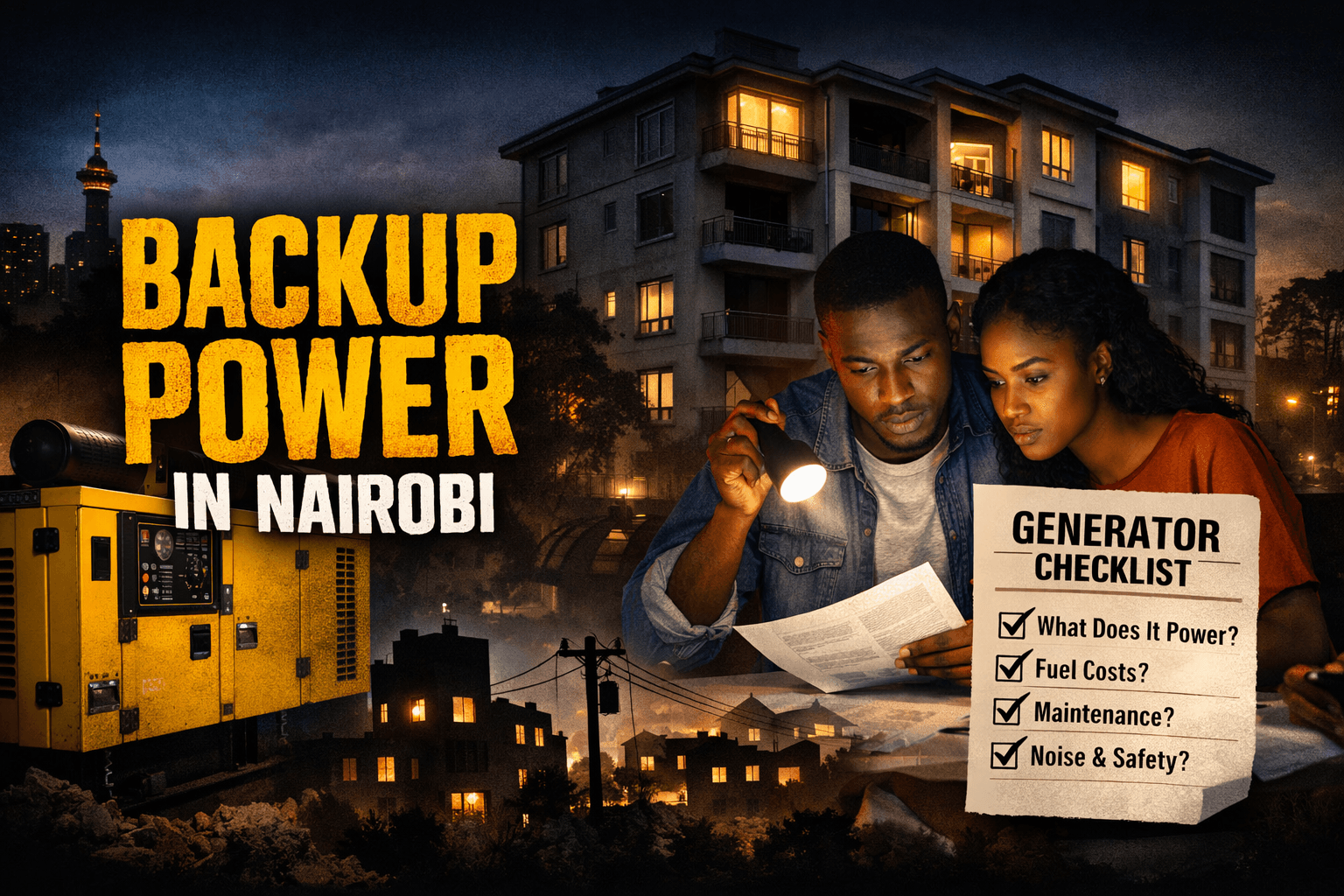
In Nairobi’s property market, the phrase “backup generator included” appears in nearly every new development brochure.
For many buyers—especially professionals working from home or diaspora investors seeking reliability—it signals peace of mind: lights stay on, work continues, and daily life remains uninterrupted.
But the phrase often hides an important truth.
A generator in a property listing is not a single standardised feature. In practice, it can mean anything from powering only the estate’s security lights to running an entire household with all appliances during a blackout.
Understanding that difference is essential for buyers navigating Nairobi’s increasingly competitive real-estate market.
Backup power has become a central feature of residential design in Nairobi because electricity interruptions are both frequent and institutionalised.
Utility provider Kenya Power and Lighting Company regularly publishes official notices titled “Interruption of Electricity Supply.” These announcements outline planned outages required for maintenance, network upgrades, or new customer connections.
While scheduled interruptions are expected, the more disruptive events are unplanned blackouts. Data from the regulator Energy and Petroleum Regulatory Authority has shown power restoration times sometimes stretching well beyond the regulator’s recommended limits.
Several structural issues contribute to the instability:
Aging infrastructure
Transmission and distribution networks have struggled to keep pace with Nairobi’s rapid urban growth.
System disturbances
Failures at generation plants or overloaded transmission lines can cause cascading outages across the grid.
Vandalism of power infrastructure
The theft of transformers and copper cables remains a persistent challenge.
Demand growth
Rapid expansion of residential and commercial developments continues to push grid capacity.
For residents, this means outages are not hypothetical inconveniences—they are a routine reality. As a result, backup power has shifted from luxury feature to basic residential infrastructure.
When developers advertise a generator, the critical question is not whether one exists but what it actually powers.
In Nairobi developments, the phrase generally falls into three categories.
This is the most common configuration in apartment developments.
The generator powers:
Elevators
Water pumps
Perimeter security lighting
Electric fences and CCTV
Corridor lighting and security systems
In this scenario, individual apartments receive no electricity during an outage. The system exists primarily to maintain building operations and safety.
A more advanced configuration allows power to reach specific circuits inside homes.
Typically supported appliances include:
Lighting
Wi-Fi routers
Refrigerators
Television and basic sockets
High-wattage equipment is usually excluded:
Electric ovens
Instant showers
Air conditioners
Heavy cooking appliances
These systems require careful electrical design because appliances with motors—such as refrigerators—can demand three to six times their running power during startup.
This is the most premium arrangement and significantly more expensive.
A high-capacity generator powers:
All household sockets
Large appliances
Water heating systems
Air conditioning
Kitchen equipment
Because the load demand is high, these systems require larger generators and more complex switchgear.
They are typically found only in high-end residential developments.
A generator alone does not determine reliability.
The transfer switch—the device that shifts electricity from the national grid to backup power—is equally important.
Two systems dominate residential installations.
An ATS constantly monitors grid power. When electricity fails, it automatically starts the generator and transfers the load within seconds.
Advantages include:
Seamless transition
No manual intervention
Reduced risk of operational error
Protection against power surges
For modern developments, an ATS is widely considered the safest and most convenient configuration.
Manual systems require a person to start the generator and physically switch the electrical supply.
While cheaper, they introduce several limitations:
Power interruptions during switching
Dependence on human intervention
Higher risk of operational mistakes
For estates with frequent outages, the difference between automatic and manual systems can dramatically affect daily convenience.
The upfront installation cost of a generator is only part of the financial picture.
The ongoing operational expenses are often shared through the estate’s service charge.
Typical generator-related expenses include:
Fuel consumption
Diesel is the most significant cost, especially during months with frequent outages.
Routine maintenance
Generators require regular servicing including oil changes and filter replacements.
Emergency repairs
Unexpected mechanical failures can lead to substantial repair bills.
Replacement reserves
Well-managed estates maintain sinking funds to replace major equipment when it reaches end of life.
In many developments, generator costs sit alongside security and lift maintenance as the largest service-charge drivers.
To understand how backup power is integrated into modern residential design, it helps to examine how infrastructure is structured in real developments.
One example is 37byINEZA, a low-density residential estate located off Kiambu Road behind Runda along Kwaheri Road.
The project consists of 37 five-bedroom townhouses with domestic staff quarters, designed across roughly five acres to maintain a private, boutique living environment.
Infrastructure provisions in the estate include:
Borehole and mains water supply
Underground water storage systems
Electric fencing and CCTV security
Controlled gate access
Backup generator infrastructure supporting estate utilities
Because the development is a townhouse estate rather than a high-rise apartment complex, the generator infrastructure is typically designed to support estate-level systems rather than large vertical building loads.
This often includes:
Water pumping systems
Security lighting
Access control systems
Estate common-area infrastructure
For buyers evaluating developments such as 37byINEZA, the presence of backup power in project specifications should prompt further verification.
Key details to confirm include:
Generator capacity (kVA rating)
Which systems are connected to backup circuits
Whether household circuits are included
How maintenance and fuel costs are managed by the homeowners’ association
These technical details determine whether the generator functions primarily as estate infrastructure protection or household power support.
Even with backup systems, residents still rely on the national grid and may occasionally need to escalate service issues.
Consumers are encouraged to first report problems through official channels operated by Kenya Power and Lighting Company, including:
The 24-hour customer contact centre
USSD service channels
Mobile self-service applications
Email and digital support platforms
If a complaint remains unresolved, consumers can escalate the matter to the national regulator, the Energy and Petroleum Regulatory Authority, which provides formal dispute resolution procedures.
While these regulatory pathways exist, their timelines reinforce why on-site backup systems remain essential for residential reliability.
Before committing to a property that advertises backup power, buyers should ask:
What exactly does the generator power?
Common areas only, partial homes, or full homes?
If partial, which circuits are included?
Lights, sockets, refrigerators, internet?
What is the generator capacity (kVA)?
Is it appropriately sized for the development?
Is the transfer switch automatic or manual?
Who pays for the fuel and how is it billed?
What is the maintenance schedule and who performs it?
Are service logs available for review?
Is there a sinking fund for generator replacement?
What happens if the generator fails during an outage?
Where are these policies documented?
In the sale agreement, estate bylaws, or service-charge framework?
Serious developments should answer these questions with written documentation rather than verbal assurances.
In Nairobi’s real estate market, a generator is not simply an amenity—it is core infrastructure that affects daily life, service charges, and long-term reliability.
For buyers evaluating homes:
Ask what stays powered during outages
Understand who pays for generator operation
Verify technical capacity and governance
Developments that provide clear documentation—load plans, maintenance records, and transparent cost structures—tend to deliver the most reliable living environments.
Because when the lights go out, the real value of a generator is no longer a marketing line in a brochure.
It is the difference between inconvenience and continuity.
Keep the conversation in one place—threads here stay linked to the story and in the forums.
Sign in to start a discussion
Start a conversation about this story and keep it linked here.
Other hot threads
E-sports and Gaming Community in Kenya
Active 9 months ago
The Role of Technology in Modern Agriculture (AgriTech)
Active 9 months ago
Popular Recreational Activities Across Counties
Active 9 months ago
Investing in Youth Sports Development Programs
Active 9 months ago