We're loading the full news article for you. This includes the article content, images, author information, and related articles.
Award-winning photographer Barry Webb unveils the vibrant, single-celled architects of our ecosystems, proving that nature’s smallest wonders hold its biggest secrets.
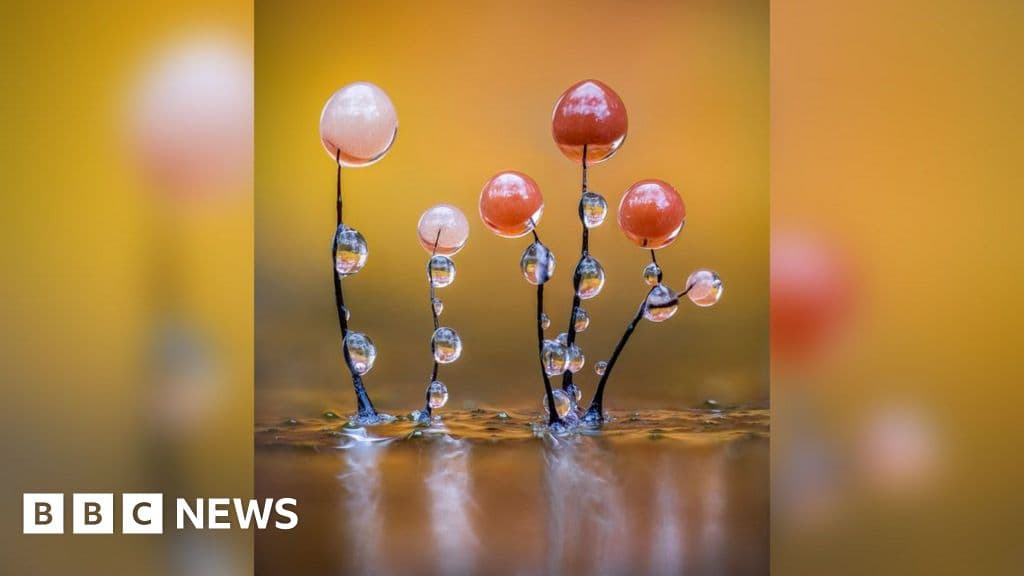
Beneath the forest floor lies a psychedelic universe invisible to the naked eye, where single-celled organisms hunt, pulse, and bloom in vibrant colour. It is a world of microscopic drama that most of us walk over without a second thought.
These are slime moulds—neither plant, animal, nor fungi—captured in breathtaking detail by photographer Barry Webb. His work exposes the hidden mechanics of decomposition that keep our planet, from the woodlands of the UK to the dense canopies of the Mau Forest, alive and functioning.
Webb, a gardener by trade, admits he was oblivious to this sub-layer of nature until relatively recently. He noted that he "didn't know they existed" before stumbling into the niche world of myxomycetes (slime moulds) in 2019.
The global stillness of the Covid-19 pandemic became a catalyst for his art. Confined by lockdowns, Webb turned his lens toward the undergrowth near his home west of London. What began as a way to pass the time evolved into an obsession with the minute details of the natural world.
His dedication recently earned him the People's Choice Award in the macro section of the British Photography Awards, a testament to the growing public fascination with the unseen.
To the uninitiated, slime moulds look like alien vegetation. However, the science tells a stranger story. "It's not fungi, it's not a plant, it's not animal. It's more closely related to an amoeba," Webb explains.
Capturing these organisms requires more than just a steady hand. Webb utilizes a high-powered macro lens and a technique known as focus stacking—creating a composite of multiple stills to achieve a depth of field impossible with a single shot. This reveals structures that rival the complexity of any large-scale architecture.
Key characteristics of these microscopic wonders include:
While Webb’s images focus on the "fruiting bodies"—the stage where colour and drama peak and spores are released—the organism's role extends far beyond aesthetics. These tiny entities are critical to the health of ecosystems.
By consuming bacteria and recycling nutrients back into the soil, slime moulds support the growth of plants and trees. For an agricultural nation like Kenya, where soil health is synonymous with food security, these invisible labourers are unsung heroes.
Webb’s portfolio serves as a vivid reminder that biodiversity isn't just about the Big Five; it is about the millions of tiny interactions that make life possible.
Keep the conversation in one place—threads here stay linked to the story and in the forums.
Sign in to start a discussion
Start a conversation about this story and keep it linked here.
Other hot threads
E-sports and Gaming Community in Kenya
Active 9 months ago
The Role of Technology in Modern Agriculture (AgriTech)
Active 9 months ago
Popular Recreational Activities Across Counties
Active 9 months ago
Investing in Youth Sports Development Programs
Active 9 months ago